
Original Source: Journal of Clinical Psychiatry, all rights reserved. —
Postpartum psychosis is one of the most acute psychiatric emergencies associated with childbirth, affecting approximately 1–2 per 1,000 women.1–3 Onset typically occurs within weeks after delivery and is marked by rapid-onset mania, depression with psychotic features, mixed episodes, or psychotic symptoms without prominent mood symptomatology.3 Postpartum psychosis carries substantial risks for severe outcomes such as suicide but responds well to prompt treatment, making early detection and intervention critical. Although a personal history of bipolar disorder remains the strongest known predictor, approximately half of affected women lack a prior diagnosis of severe mental illness,4 highlighting the need to identify additional risk factors.
Recent large-scale epidemiological studies have revealed that postpartum psychosis exhibits one of the strongest familial aggregation patterns among psychiatric disorders.5 In a nationwide Swedish cohort, having a full sister with postpartum psychosis conferred a 10.7-fold increased risk (95% CI, 6.6–16.3) of developing the condition.5 This relative recurrence risk exceeds that reported for many chronic psychiatric conditions, including bipolar disorder and schizophrenia.6 Postpartum psychosis is closely linked with bipolar disorder, given overlapping symptomatology, favorable treatment response to lithium and electroconvulsive therapy, and a long-term course often marked by manic or depressive episodes.4,7 Polygenic risk score analyses indicate that women with postpartum psychosis share bipolar and schizophrenia risk alleles with women with bipolar disorder, but not major depression risk alleles, suggesting a partially distinct genetic architecture.8,9 Recent studies demonstrate that postpartum psychosis is highly heritable, with a heritability of 55% based on familial data and 37% from genomic data.8 Previous Danish registry research found that family history of bipolar disorder increases risk of any postpartum psychiatric illness (hazard ratio=2.86; 95% CI, 1.88–4.35), while family histories of schizophrenia and major depression confer more modest risks.10 However, these studies have not isolated postpartum psychosis specifically, nor focused on sibling diagnoses, a clinically accessible source of familial psychiatric risk.
The mechanisms underlying familial aggregation of postpartum psychosis likely reflect an interaction between shared genetic liability and the experience of childbirth. Under a gene-environment interaction framework, inherited vulnerability to mood-psychotic illness, reflected in familial psychiatric history, may remain latent until triggered by the physiological changes of parturition.4 Consistent with this view, postpartum psychosis occurs exclusively in the context of childbirth, yet the underlying psychiatric vulnerability it expresses, characterized by bipolar-spectrum risk alleles, is present and transmissible across family members regardless of reproductive experience.8,9 This framework predicts that familial psychiatric history should index postpartum psychosis risk even when the sibling’s illness was not postpartum-onset and that the pattern of cross-diagnostic aggregation should reflect the broader mood-psychotic liability architecture rather than postpartum-specific transmission alone.5,8
Accordingly, in this population-based cohort study, we used Swedish national registers to evaluate whether having a full sibling with any psychiatric disorder is associated with increased risk of postpartum psychosis. We examined familial coaggregation across a broad spectrum of psychiatric diagnoses, including mood, anxiety, psychotic, personality, neurodevelopmental, and substance use disorders. We additionally assessed whether familial associations differed by sibling sex and by the woman’s own psychiatric history, wherein the aforementioned diagnoses were grouped into one of the following categories: none, nonmanic/nonpsychotic, or manic/psychotic.
METHODS
Study Population
This nationwide cohort study combined data from multiple Swedish national registers. Sweden assigns a unique personal identification number to all residents, enabling linkage across multiple national registers.11
From the Swedish Medical Birth Register, we identified all women who delivered their first live-born child between January 1, 1980, and October 31, 2017. This register includes more than 98% of births in Sweden.12 We required the index delivery to occur on or before October 31, 2017, to ensure a complete 90-day postpartum follow-up within the observation window.
Full siblings, defined as individuals sharing both biological parents, were identified using the Swedish Multi-Generation Register, which documents parent-child relationships with near-complete coverage (97% for mothers and 95% for fathers).11 Women were included in the analytic cohort if at least 1 full sibling could be identified. Complete sibling ascertainment was achieved for individuals born in 1980 or later; see Sensitivity Analyses for discussion of earlier birth cohorts.
The Swedish Ethical Review Authority approved the study and waived the requirement for informed consent owing to the use of de-identified registry data.
Exposure, Outcome, and Covariates
Diagnostic sources. Diagnostic data were obtained from the Swedish National Patient Register, which includes all inpatient psychiatric care nationwide since 1987 and outpatient visits since 2001. Diagnoses are made by clinicians and registered using the International Classification of Diseases (ICD): ICD-8 (1969–1986), ICD-9 (1987–1996), and ICD-10 (1997–2017). The register has been extensively validated with positive predictive values for major psychiatric disorders, including bipolar disorder and schizophrenia-spectrum illnesses, exceeding 85% to 95%, and kappa statistics ranging from 0.74 to 0.87 for diagnostic agreement.13,14 Although specialist outpatient coverage was limited in earlier years and milder conditions may be underreported, postpartum psychosis generally requires hospitalization, thereby minimizing risk of outcome misclassification.
Outcome definition. The primary outcome, postpartum psychosis, is one of the clearest phenotypes in psychiatry but lacks accurate diagnostic criteria in major classification systems like the Diagnostic and Statistical Manual of Mental Disorders (DSM).1 Therefore, to identify postpartum psychosis cases, we applied a diagnostic classification widely used in the literature across both inpatient and outpatient registers: patients with mania and/or psychosis with onset in the postpartum period.1
Similar to previous studies,5 case definition included postpartum-onset mania, psychosis, or depression with psychotic features, using the following diagnostic codes: ICD-10 (F23, F28, F29, F30, F31, F323, F333, F531); ICD-9 (296A, 296G, 298A, 298B, 298X); and ICD-8 (2961, 2963, 2968, 2969, 2981, 2944).
To maximize case ascertainment, we included both primary and secondary diagnoses with symptom onset within 0–3 months following a woman’s first live-born childbirth. We selected this 3-month period to ensure comprehensive coverage of the typical onset window and to account for delayed diagnosis, consistent with previous epidemiological studies.2,3,15–17
Exposure definition. The primary exposure for the index woman was having a full sibling with a psychiatric diagnosis recorded in the National Patient Register. We did not restrict exposure to older siblings; any full-sibling diagnosis was considered valid, and, for the risk estimation analyses, diagnoses were restricted to those occurring before the index woman’s first childbirth (anchor date) to ensure temporal ordering between exposure and outcome. For descriptive purposes, we additionally summarized lifetime sibling diagnoses, but all risk estimates were based on prechildbirth exposures. Because exposures were restricted to sibling diagnoses recorded before the index woman’s first childbirth, younger siblings had less time to accumulate psychiatric diagnoses relative to older siblings at the same anchor date. This asymmetry would tend to underclassify younger siblings as unexposed, effectively misclassifying some siblings with genuine psychiatric vulnerability as unaffected. The direction of this bias is toward the null: To the extent that younger siblings are incorrectly assigned to the unexposed group, the observed associations between sibling psychiatric diagnoses and postpartum psychosis risk are likely underestimates of the true familial aggregation. This conservative bias strengthens rather than undermines the interpretation of the significant associations reported here, as the true familial effects may be larger than our estimates suggest.
Sibling diagnostic categories were selected using a 2-tier approach. Primary analyses focused on mood and psychotic spectrum disorders, specifically bipolar disorder, schizoaffective disorder, schizophrenia, cyclothymia, brief psychotic disorder, and major depressive disorder, prespecified on the basis of established genetic and clinical overlap with postpartum psychosis.4,5,8,9 Secondary analyses extended this to the full range of psychiatric diagnoses available in the National Patient Register, including anxiety, personality, neurodevelopmental, substance use, and other disorders, and were treated as explicitly exploratory. This comprehensive approach was justified by the registry setting, which permits unbiased assessment of familial aggregation across the diagnostic spectrum, and by the incompletely characterized genetic architecture of postpartum psychosis, which precludes confident a priori exclusion of diagnostic categories.
In the primary analysis, we included as covariates the calendar year of the index woman’s first delivery to account for temporal changes in diagnostic and reporting practices and the woman’s age at first childbirth to adjust for age-related risk differences.
Statistical Analysis
We first described cohort characteristics using medians and interquartile ranges (IQRs) for continuous variables and counts and percentages for categorical variables.
To evaluate familial aggregation of postpartum psychosis, we fitted logistic regression models with postpartum psychosis as the binary outcome and sibling psychiatric diagnoses as the main exposures. Analyses were based on mother-sibling pairs identified in the pedigree, with each pair contributing a single observation. For each diagnostic category, we created binary indicators indicating whether the sibling had the diagnosis of interest, and we restricted exposures to diagnoses recorded before the woman’s first childbirth to preserve temporal ordering in the risk estimates. Consistent with our prespecified modeling rule to avoid unstable estimates, diagnostic categories with fewer than 2 outcome events were not analyzed further and therefore do not appear in the results tables. Cluster-robust standard errors were used in all models to account for nonindependence of pairs within families. Models were adjusted for the woman’s age at first birth and calendar year of first birth. Familial associations were first estimated in sister-sister pairs and then in brother-sister pairs, and we also fitted combined models including both sisters and brothers to summarize overall sibling effects. Results are presented as odds ratios (ORs) with 95% confidence intervals. All ICD-8, ICD-9 Swedish letter-code, and ICD-10 definitions used to construct each diagnostic category are provided in Supplementary Table 1.
To quantify the contribution of the woman’s own psychiatric history, we next examined associations between her prechildbirth psychiatric diagnoses and postpartum psychosis in the full mother cohort. For each of the predefined diagnostic categories, we fitted logistic regression models with postpartum psychosis as the outcome and the presence of the diagnosis before the first birth as the exposure, adjusting for age and year at first childbirth.
We then evaluated whether sibling psychiatric history provided information beyond the woman’s own psychiatric background using hierarchical logistic regression. Mothers were classified into 3 mutually exclusive groups according to their prechildbirth diagnoses: no prior psychiatric diagnosis; prior nonmanic, nonpsychotic disorders; and prior manic or psychotic disorders, defined as bipolar disorder, schizophrenia, or schizoaffective disorder. Within each stratum, we compared a base model that included maternal age and childbirth year, with or without an indicator of prior diagnosis, to an extended model that additionally included the sibling’s diagnosis of interest. Likelihood ratio tests were used to assess model improvement, and changes in Nagelkerke pseudo-R2 were calculated to quantify the incremental predictive value of sibling diagnoses. The OR for the sibling diagnosis from the extended model was interpreted as the association between sibling history and postpartum psychosis within each level of the grouped prechildbirth diagnoses.
Because multiple diagnostic categories were examined across families, we applied false discovery rate (FDR) correction to P values using the Benjamini-Hochberg procedure, controlling the FDR at 5%. Correction was applied separately within each analytical subset, specifically within the combined sibling model, the sister-sister model, and the brother-sister model, with each subset including both lifetime and prechildbirth timing conditions, yielding families of 44 tests per subset. Correction was not applied jointly across all analytical subsets simultaneously, reflecting the conceptually distinct nature of each set of comparisons; readers should note that this approach is more lenient than joint correction across all tests. FDR correction was applied to P values only; confidence intervals are unadjusted and presented as calculated from the clustered standard errors. Sensitivity analyses assessed the robustness of key findings to birth cohort and sibship size. We repeated sibling analyses, adjusting for maternal birth cohort, and compared ORs from models with and without cohort adjustment. We also reestimated bipolar sibling associations within categories of sibship size to examine whether estimates were consistent among women with 1, 2 to 3, or 4 or more siblings.
RESULTS
Study Population and Descriptive Statistics
A total of 1,213,829 women with at least 1 full sibling were included in the analyses. Among these, 1,831 were diagnosed with postpartum psychosis within 90 days of their first live-born delivery, corresponding to a prevalence of 1.5 per 1,000. The median maternal age at first delivery was 27 years (IQR 24–31), and the median year of childbirth was 1997 (IQR 1987–2008).
Among women with postpartum psychosis, 72.1% had at least 1 documented psychiatric diagnosis before childbirth, with just over half (53.2%) having bipolar disorder (see Table 1). Major depressive disorder without bipolar disorder affected a small proportion of the sample (8.1%), and anxiety disorders affected nearly one-third (29.3%).
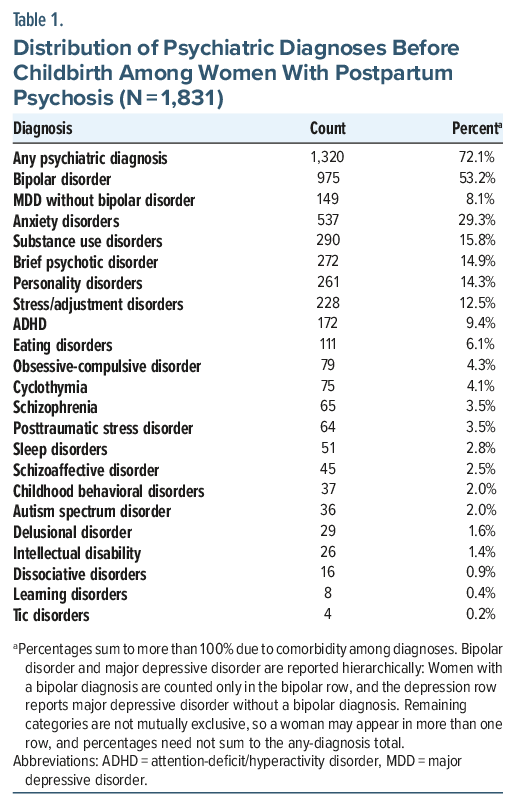
Beyond mood disorders, substance use disorders (15.8%), brief psychotic disorder (14.9%), and personality disorders (14.3%) were also prevalent. Less common but clinically relevant diagnoses included stress/adjustment disorders (12.5%), attention-deficit/hyperactivity disorder (9.4%), and psychotic spectrum disorders such as schizophrenia (3.5%) and schizoaffective disorder (2.5%).
Familial Aggregation Analysis
The strongest familial association was postpartum psychosis itself: Women whose sister had previously experienced postpartum psychosis had a significantly increased risk for postpartum psychosis (OR = 10.84; 95% CI, 5.76–20.40), representing the highest familial clustering observed across all psychiatric conditions examined. Since postpartum psychosis can only affect female siblings, estimates were not included in the combined sibling model or the sister versus brother comparison analysis.
A broader pattern emerged linking a wide range of sibling psychiatric disorders to postpartum psychosis risk (Table 2). Disorders characterized by mood cyclicity showed the strongest associations. Cyclothymia conferred an approximately 8-fold increased risk (OR = 8.29; 95% CI, 4.65–14.76), while schizoaffective disorder showed nearly an 8-fold increase (OR = 7.90; 95% CI, 4.99–12.52). Bipolar disorder, the most prevalent serious psychiatric disorder among siblings, demonstrated an approximately 5-fold elevation in risk (OR = 5.00; 95% CI, 4.23–5.90).
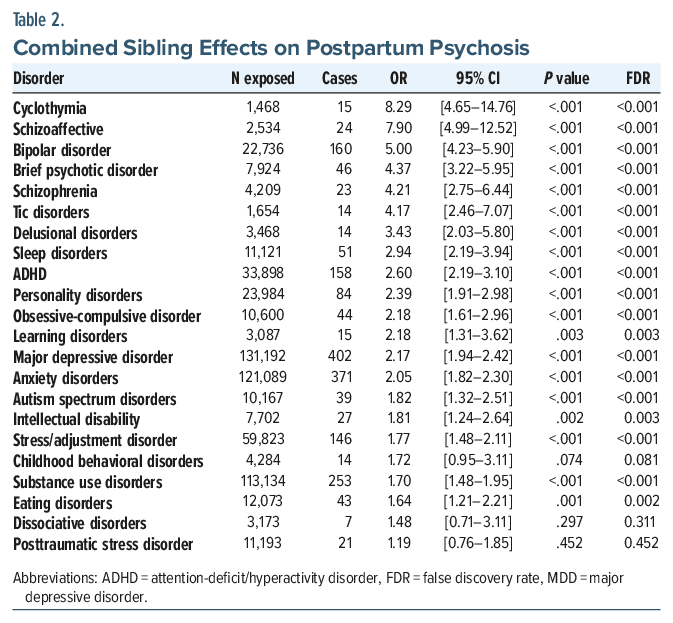
Other psychotic spectrum disorders beyond mood pathology also showed substantial associations: brief psychotic disorder (OR = 4.37; 95% CI, 3.22–5.95), schizophrenia (OR = 4.21; 95% CI, 2.75–6.44), and delusional disorder (OR = 3.43; 95% CI, 2.03–5.80) each at least tripled postpartum psychosis risk. More common psychiatric conditions, including major depressive disorder (OR = 2.17; 95% CI, 1.94–2.42) and anxiety disorders (OR = 2.05; 95% CI, 1.82–2.30), were associated with approximately 2-fold increases in risk.
Psychotic-spectrum conditions such as delusional disorder, brief psychotic disorder, and psychosis not otherwise specified were included in the diagnostic mappings but were omitted from some stratified analyses because they produced fewer than 2 postpartum psychosis cases among exposed sibling pairs, precluding stable estimation.
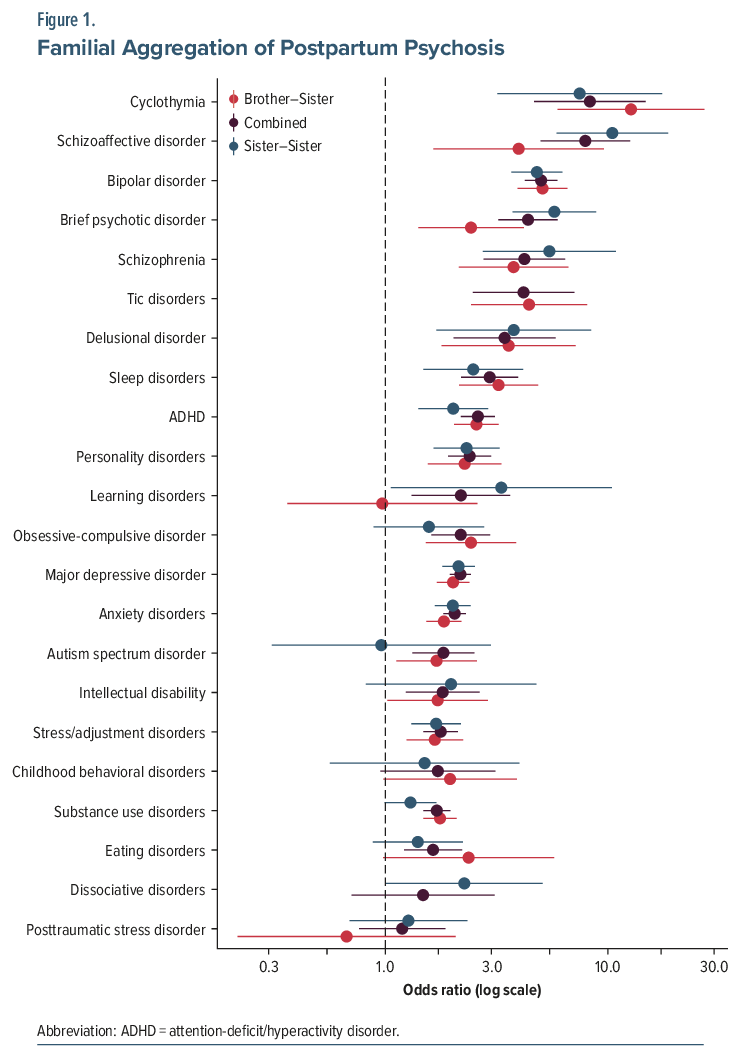
Sex-specific patterns emerged when examining sister-sister versus brother-sister concordance with postpartum psychosis (Figure 1; Supplementary Table 2 and Supplementary Table 3). Psychotic spectrum disorders showed markedly stronger sister-to-sister risk: Schizoaffective disorder conferred a 10-fold increase in risk through sisters (OR = 10.44) versus 4-fold through brothers (OR = 3.96), and brief psychotic disorder showed nearly 6-fold risk through sisters (OR = 5.74) versus 2- fold through brothers (OR = 2.42). Conversely, cyclothymia demonstrated stronger brother-to-sister concordance with postpartum psychosis (OR = 12.67) compared with sister-to-sister (OR = 7.44). For most other disorders, including bipolar disorder, depression, and anxiety, effect sizes remained broadly similar by sibling sex.
Independent Contribution of Sibling Psychiatric History
The predictive value of sibling psychiatric history varied by the woman’s own psychiatric status (Table 3). Among women with no prior psychiatric diagnosis, several sibling psychiatric disorders were strongly associated with postpartum psychosis. Schizoaffective disorder in a sibling was associated with nearly a 5-fold increase in risk (OR = 4.82; 95% CI, 2.99–7.74), cyclothymia showed a similarly large association (OR = 4.61; 95% CI, 2.52–8.43), and bipolar disorder was associated with a 3-fold increase in risk (OR = 3.07; 95% CI, 2.59–3.64). Brief psychotic episodes, schizophrenia, and several other disorders also substantially increased the risk in this psychiatrically healthy subgroup.
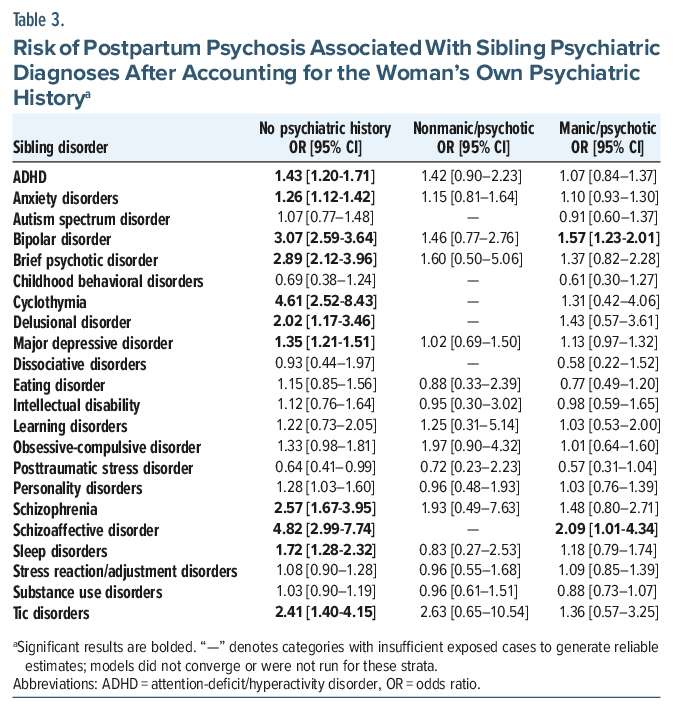
In women with nonmanic, nonpsychotic psychiatric histories, the predictive value of sibling diagnoses was markedly reduced. Associations were generally attenuated, and confidence intervals were wide, with no disorder showing a clear independent effect.
Among women with personal manic or psychotic histories, sibling psychiatric information contributed little additional predictive value. Most associations were close to the null; only bipolar disorder (OR = 1.57; 95% CI, 1.23–2.01) and schizoaffective disorder (OR = 2.09; 95% CI, 1.01–4.34) showed modest independent associations.
Sensitivity Analysis for Differential Sibling Ascertainment
Full numerical results from these sensitivity analyses are presented in Supplementary Tables 4–6. Sensitivity analyses focused on the key sibling diagnoses that contributed the strongest and most stable associations in the primary models (bipolar disorder, schizoaffective disorder, schizophrenia, major depressive disorder, anxiety disorders, personality disorders, and substance use disorders). These conditions were selected because they account for the majority of familial aggregation observed in our main results and occurred with sufficient frequency to support sensitivity analyses.
Adjustment for maternal birth year had minimal impact on the familial associations. Although point estimates shifted slightly after cohort adjustment, in all cases the adjusted OR lay within the 95% confidence interval of the corresponding unadjusted estimate, indicating that the magnitude of each association was largely unchanged. For example, the OR for sibling schizophrenia changed from 3.69 (95% CI, 2.45–5.57) to 4.21 (95% CI, 2.79–6.36), while bipolar disorder (4.94–5.00), major depressive disorder (2.25–2.17), and anxiety disorders (2.29–2.05) showed similarly modest movements with substantial overlap in confidence intervals. The association with sibling schizoaffective disorder remained strong after adjustment (6.32–7.90), again well within the range of the unadjusted estimate.
Estimates were also similar across maternal birth cohorts: The sibling bipolar association remained elevated across women born in 1980–1989 (OR = 3.35), 1990–1999 (OR = 6.11), 2000–2009 (OR = 4.82), and 2010 onward (OR = 5.52). Finally, checks by sibship size indicated that the bipolar association was present across women with 1 sibling (OR = 4.98), 2 to 3 siblings (OR = 5.37), and 4 or more siblings (OR = 3.57).
Overall, estimates for the main sibling diagnoses were similar after adjustment for maternal birth year and across maternal birth cohorts and sibship-size strata.
DISCUSSION
In this nationwide cohort of more than 1.2 million Swedish women with at least 1 full sibling, we found strong familial aggregation of postpartum psychosis, with elevated risks associated with a broad range of sibling psychiatric diagnoses. The strongest association was for postpartum psychosis in a sister, which conferred an approximately 11-fold increase in risk, followed by cyclothymia, schizoaffective disorder, and bipolar disorder. These findings extend prior work by demonstrating that familial liability for postpartum psychosis is not limited to bipolar or psychotic disorders but spans multiple diagnostic categories.
Consistent sex-specific patterns emerged. Across most diagnostic categories, associations were of similar magnitude in sister-sister and brother-sister pairs, but some psychotic-spectrum conditions, particularly schizoaffective disorder and brief psychotic disorder, showed stronger transmission through sisters than brothers. However, these sex-specific patterns warrant cautious interpretation beyond concerns about statistical power alone. Stronger sister-to-sister associations are equally consistent with sex-linked biological mechanisms, including sex-specific hormonal biology or shared reproductive physiology, as they are with shared environmental explanations.4,8 Because postpartum psychosis is a female-specific phenotype, stronger sister-to-sister transmission may reflect shared susceptibility to the postpartum trigger rather than a distinct environmental pathway, and the current design cannot differentiate between these explanations.5 The sex-specific patterns reported here are therefore best interpreted as hypothesis-generating observations that motivate future work integrating genomic data with sex-stratified analyses, rather than as evidence for a particular mechanism of familial transmission.
Stratification by the woman’s own psychiatric history revealed that sibling diagnoses are most informative among women with no prior psychiatric illness. In psychiatrically healthy women, sibling bipolar disorder, schizoaffective disorder, cyclothymia, schizophrenia, and brief psychotic disorder were all associated with substantial increases in postpartum psychosis risk. Among women with nonmanic, nonpsychotic disorders, associations were attenuated, and confidence intervals were wide. Among women with a history of manic or psychotic disorders, sibling diagnoses contributed little additional predictive value, indicating that personal psychiatric history dominates risk in this subgroup. Together, these findings highlight that family history may be particularly important for identifying elevated risk in clinically healthy women who lack standard risk markers.
The pattern of familial aggregation observed here is broadly consistent with the gene-environment interaction framework, wherein inherited mood-psychotic vulnerability remains latent until triggered by the hormonal and physiological upheaval of childbirth.4 The clustering of the strongest associations among mood-cycling disorders, specifically cyclothymia, bipolar disorder, and schizoaffective disorder, suggests that the core heritable vulnerability may be more precisely characterized as susceptibility to affective instability than as generalized psychotic liability, potentially expressed through converging postpartum physiological mechanisms including estrogen and progesterone withdrawal, hypothalamic-pituitary-adrenal axis recalibration, immunological rebound, and circadian disruption.4,18,19 Prior work demonstrating that sensitivity to gonadal steroid fluctuations may itself be heritable further supports the view that familial transmission includes not only mood-psychotic vulnerability broadly but also specific susceptibility to hormonally triggered affective destabilization.7,8 The near-null associations for PTSD and dissociative disorders are particularly informative in this regard: If familial clustering reflected a generalized stress-vulnerability diathesis, elevated risks would be expected for these conditions as well, and their absence argues against nonspecific environmental explanations in favor of a model in which shared genetic variants predisposing to mood cycling confer the core familial liability, with shared environmental exposures such as childhood adversity potentially potentiating hormonal sensitivity independently of inherited psychiatric risk.8–10,20
Overall, our results strengthen the view that postpartum psychosis reflects a severe mood-psychotic vulnerability with a distinct familial signature. Although postpartum psychosis shares genetic and clinical features with bipolar disorder, the substantially stronger aggregation of postpartum psychosis relative to bipolar disorder suggests a liability that is partly specific to the postpartum phenotype. The broad pattern of cross-disorder aggregation, including associations with schizophrenia-spectrum disorders and mood-anxiety conditions, further indicates that multiple familial pathways contribute to postpartum psychosis risk and that identifying women at elevated familial risk may be most clinically valuable precisely among those who lack prior psychiatric diagnoses and would otherwise go unrecognized.
Several limitations merit consideration. First, sibling ascertainment is incomplete for women born before 1980, although sensitivity analyses indicate little impact on effect estimates. Second, because exposures were restricted to sibling diagnoses recorded before the index woman’s first childbirth, younger siblings had less opportunity to accumulate diagnoses, likely resulting in underclassification of some exposed siblings and biasing familial associations toward the null. Third, use of registry-based diagnoses may capture milder psychiatric conditions or those treated exclusively in primary care, and associations with common disorders such as anxiety and depression should be interpreted with this in mind, as siblings receiving only primary care treatment for these conditions would be misclassified as unaffected, likely underestimating their true familial associations with postpartum psychosis. Fourth, although models were adjusted for maternal age and calendar year of childbirth, other potential confounders were not accounted for, including socioeconomic factors, and family-level variables such as shared household composition or access to psychiatric care. These factors could independently elevate psychiatric risk across siblings and may contribute to the familial aggregation observed, particularly for the more modest associations with common disorders such as depression and anxiety. Distinguishing between these pathways will require designs that can decompose genetic and environmental variance, such as adoption studies, discordant sibling designs, or analyses integrating genomic data with detailed environmental exposure histories. Fifth, the sibling design cannot distinguish whether familial risk for postpartum psychosis reflects an inherited sensitivity to postpartum endocrine change specifically, or genetic liability for mood-psychotic illness that is expressed postpartum given the hormonal trigger of delivery. Women may carry familial risk for severe affective or psychotic episodes broadly, with childbirth serving as a precipitant rather than a specific biological target. Disentangling these possibilities will require designs that directly measure hormonal responsivity alongside psychiatric phenotyping, such as studies of hormonal challenge paradigms in women with and without familial loading, or longitudinal cohorts tracking endocrine trajectories through the perinatal period in high-risk families. The final limitation concerns associations based on small case numbers in sex-stratified analyses. The cyclothymia findings illustrate this most clearly: Despite one of the strongest overall associations in the combined model, sex-stratified estimates were based on only 8 cases in sister-sister pairs and 7 in brother-sister pairs, and the apparent discrepancy in effect sizes between sibling-sex groups may reflect differences in exposure counts rather than true mechanistic differences in transmission. Primary interpretive weight should therefore be placed on diagnostic categories with larger case numbers, particularly bipolar disorder, schizoaffective disorder, schizophrenia, major depressive disorder, and anxiety disorders.
Future work integrating genomic data, hormonal markers, and detailed clinical phenotyping will be needed to clarify the biological pathways underlying familial risk for postpartum psychosis and to determine whether specific familial profiles predict treatment response or long-term outcomes. Genome-wide association studies and polygenic risk score analyses in postpartum psychosis cohorts that include sibling data would help determine whether the mood-cycling specificity observed here reflects shared variants in circadian regulation, monoaminergic, or neuroimmune pathways. Genomic comparisons between affected and unaffected siblings would be particularly well suited to decomposing genetic and environmental contributions in a way the current population-based design cannot achieve. Determining whether specific familial profiles predict treatment response or long-term outcomes would have direct clinical value, and prospective cohort studies following high-risk women identified through sibling psychiatric history could evaluate whether family history of bipolar disorder versus schizoaffective disorder versus cyclothymia differentially predicts lithium response, recurrence risk across subsequent pregnancies, or long-term diagnostic trajectory. Identification of high-risk women through family history may ultimately support targeted monitoring and preventive strategies during the perinatal period , and the familial aggregation patterns identified here provide a foundation for developing clinically actionable risk stratification tools that extend beyond personal psychiatric history alone.
Article Information
Published Online: November 2, 2026. https://doi.org/10.4088/JCP.26m16393
© 2026 Physicians Postgraduate Press, Inc.
Submitted: February 21, 2026; accepted August 26, 2026.
To Cite: Smout S, Milazzo F, Robakis TK, et al. Sibling psychiatric diagnoses and risk of postpartum psychosis: a nationwide cohort study. J Clin Psychiatry 2026;87(4):26m16393.
Author Affiliations: Seaver Autism Center for Research and Treatment, Icahn School of Medicine at Mount Sinai, New York, New York (Smout, Mahjani); Department of Psychiatry, Icahn School of Medicine at Mount Sinai, New York, New York (Smout, Milazzo, Robakis, Bergink, Mahjani); Department of Psychiatry, Erasmus Medical Center, Rotterdam, The Netherlands (Bergink); Department of Genetics and Genomic Sciences, Icahn School of Medicine at Mount Sinai, New York, New York (Mahjani); Department of Artificial Intelligence and Human Health, Icahn School of Medicine at Mount Sinai, New York, New York (Mahjani); the Mindich Child Health and Development Institute, Icahn School of Medicine at Mount Sinai, New York, New York (Mahjani); Department of Molecular Medicine and Surgery, Karolinska Institutet, Stockholm, Sweden (Mahjani); Department of Medical Epidemiology and Biostatistics, Karolinska Institutet, Stockholm, Sweden (Mahjani).
Corresponding Author: Behrang Mahjani, PhD, One Gustave L. Levy Place, Box 1230, New York, NY 10029 ([email protected]).
Drs Bergink and Mahjani contributed equally as senior authors.
Author Contributions: Study concept and design: (Bergink, Mahjani, Smout); acquisition, analysis, or interpretation of data: (Bergink, Mahjani, Milazzo, Robakis, Smout); drafting of the manuscript: (all authors); critical revision of the manuscript for important intellectual content: (all authors); statistical analysis: (Mahjani, Milazzo, Smout); obtained funding: (Bergink, Mahjani); study supervision: (Bergink, Mahjani).
Financial Disclosure: Dr Robakis receives research funding from the National Institute of Child Health and Human Development and the Department of Defense. She serves as a consultant for the Motherhood Center of New York and sits on a Data Safety and Monitoring Board for a clinical trial by Reunion Neuroscience. The other authors have no conflicts of interest to disclose.
Funding/Support: This study was supported by a grant from the Beatrice and Samuel A. Seaver Foundation (Drs Smout and Mahjani) and by the National Institute of Mental Health, grants R21MH131933 (Dr Mahjani), R01 HD111117 (Dr Robakis), and R01MH122869 (Dr Bergink).
Role of the Sponsor: The funders had no role in the design, analysis, interpretation, or publication of this study.
Data Availability Statement: Data may be obtained from a third party and are not publicly available. Data cannot be shared publicly owing to restrictions by law. Data are available from the National Medical Registries in Sweden after approval by the Swedish Ethical Review Authority.
Ethical Standards: The Swedish Ethical Review Authority approved the study and waived the requirement for informed consent owing to the use of de-identified registry data.
Supplementary Material: Available at Psychiatrist.com.
Clinical Points
- Approximately half of women who develop postpartum psychosis have no prior psychiatric diagnosis, highlighting a critical gap in identifying at-risk women. Sibling psychiatric history represents a clinically accessible source of familial risk information that extends beyond personal history alone.
- Familial risk for postpartum psychosis extends across a broad range of sibling psychiatric diagnoses, with the strongest associations clustering among mood-cycling disorders, supporting conceptualization of postpartum psychosis as a postpartum-triggered expression of heritable affective instability.
- Sibling psychiatric history is most informative for identifying risk in women with no prior psychiatric diagnosis, precisely the group least likely to receive targeted perinatal monitoring. Routine collection of family psychiatric history during perinatal care may support earlier identification and preventive intervention.
Editor’s Note: We encourage authors to submit papers for consideration as a part of our Focus on Women’s Mental Health section. Please contact Marlene P. Freeman, MD, at Psychiatrist.com/contact/freeman.
Journal of Clinical Psychiatry, all rights reserved.