
From Hospital to Outpatient Care After Long-Acting Injectable Antipsychotic Initiation in Bipolar Disorder: Nationwide Evidence From Taiwan
Journal of Clinical Psychiatry | October 21, 2026

Original Source: Journal of Clinical Psychiatry, all rights reserved. —
Bipolar disorder (BD) is a recurrent, episodic illness. Long-term pharmacotherapy is central to relapse prevention, yet treatment nonadherence is common and clinically consequential, as it is consistently linked to higher risks of relapse, hospitalization, and suicidality, as well as greater overall illness burden.1–4 Moreover, nonadherence in BD is often driven by illness-intrinsic, state-dependent mechanisms rather than simple “patient compliance.” BD-intrinsic drivers include fluctuations in insight during (hypo)mania, perceived short-term benefits of activation (eg, increased energy and productivity) that can reinforce intentional discontinuation, and destabilization related to sleep/circadian disruption and comorbid substance use.5,6 In addition, medication adverse effects and regimen complexity further contribute to discontinuation and irregular dosing patterns.7,8 Accordingly, modifiable factors that directly target illness awareness, early-warning signs, and routine stabilization (eg, structured psychoeducation and family-focused therapy) have demonstrated benefits not only for relapse prevention but also for improving medication adherence. Thus, adherence is considered to be a modifiable mechanism that mediates long-term outcomes in BD.5,6
Adherence-enhancing strategies that improve continuity of medication exposure, especially when daily oral adherence is unreliable, represent a pragmatic way to reduce relapse and improve long-term outcomes. Along these lines, long-acting injectable antipsychotics (LAIs) have become important tools for strengthening continuity of care and reducing on–off medication cycling.9–11 Meta-analyses of randomized controlled trials and systematic reviews support the use of LAIs in BD, with benefits most consistently observed for relapse prevention.12,13 Converging real-world mirror-image data further suggest that clinically meaningful reductions in hospitalization occur after LAI initiation, reinforcing the pragmatic value of these medications for patients with recurrent relapse or unreliable oral adherence.10 Evidence from Taiwan is in line with these patterns, as a retrospective cohort study conducted at a tertiary-care center found significantly lower 1-year rehospitalization following the addition of LAIs during manic episodes.14 Similarly, a national claims-based mirror-image study reported reduced hospitalization rates and health care costs with regular Risperdal Consta usage.15 Moreover, cross-national data from the REAP-BD program, which included Taiwanese sites, highlight substantial regional variability in LAI prescribing and underscore the need for localized guidance and implementation strategies.16
Taiwan’s policy approach to LAI use has increasingly shifted from a medication-centered decision to a continuity-of-care strategy. National guidance embeds LAIs within early-intervention pathways and shared decision-making, and the National Health Insurance (NHI) supports sustained LAI administration and outreach for patients with irregular care engagement. However, real-world evidence remains limited regarding whether, within a single-payer system, LAI initiation is associated with psychiatric service-use patterns consistent with improved continuity of care in BD. Using nationwide NHI data from 2015 to 2024, we examined second-generation long-acting injectable antipsychotic (SGA-LAI) initiation and treatment persistence in BD and evaluated changes in psychiatric outpatient, emergency, and inpatient service utilization during the 12 months before and after LAI initiation. We further treated sustained, label-frequency-concordant use as an implementation-relevant indicator of continued engagement with LAI-based care, rather than as a surrogate marker of superior pharmacologic efficacy.
METHODS
Study Design
The NHI data are a nationwide health care utilization dataset from Taiwan’s single-payer compulsory NHI program, which covers more than 99.6% of the 23 million people in Taiwan.17,18 Using the NHI data (2015–2024), we conducted a nationwide, retrospective mirror-image study of individuals with BD (International Classification of Diseases, Ninth Revision, Clinical Modification [ICD-9-CM] code 296.4–296.7; International Statistical Classification of Diseases and Related Health Problems, Tenth Revision [ICD-10] code F31) who received LAI antipsychotics. This study was focused on patients initiating SGA-LAIs and followed individuals for 12 months after the index injection.
The analytic framework incorporated both patient-level and provider-level covariates. At the individual level, we extracted demographic characteristics (eg, age and sex), insurance-related indicators (eg, monthly insured payroll amount, where available), and clinical history variables capturing illness severity and psychiatric care use (eg, prior emergency department visits and hospitalizations), timing of BD diagnosis, and the specific SGA-LAI agent initiated. At the hospital level, we characterized care setting attributes. The mirror-image design compared each patient’s psychiatric health care utilization in the 12-month preindex observation window with the 12-month postindex follow-up window. Primary outcomes were psychiatric emergency department utilization and psychiatric inpatient utilization. Each was assessed using event counts and associated expenditures. Inpatient outcomes included length of stay (LOS). This design enabled within-person comparisons of changes in acute psychiatric care use and costs before versus after SGA-LAI initiation within Taiwan’s NHI system.
The analytic dataset was constructed from the NHI data by linking outpatient and inpatient claims at the order and patient levels. Outpatient prescriptions/orders were retrieved from the outpatient order header file and linked to outpatient order details via the unique detail identifier; inpatient prescriptions/orders were retrieved from the inpatient order header file and linked to inpatient order details using the same identifier. First-time use of SGA-LAIs between 2015 and 2024 was ascertained from these order tables, capturing patient identifiers (ID and date of birth), service dates, primary diagnosis codes (ICD-9-CM/ICD-10-CM), and claim item identifiers. For the mirror-image design, utilization variables were extracted separately for the 12 months before and 12 months after the index SGA-LAI initiation date for each individual. The design enabled within-person comparisons of psychiatric outpatient, emergency, and inpatient service use along with associated costs.
Stable use was defined according to the label-specified injection frequency for each SGA-LAI agent during the 12-month follow-up period. Specifically, patients were classified as stable users if their observed number of injections met or exceeded the minimum recommended frequency specified in the product label for the initiated LAI formulation. For monthly formulations, including Abilify Maintena and Invega Sustenna, stable use required at least 12 injections during the first postindex year; for Risperdal Consta, which is administered every 2 weeks, stable use required at least 24 injections; and for Invega Trinza, which is administered every 3 months, stable use required at least 4 injections. This definition was intended to capture sustained, label-frequency-concordant engagement with LAI-based care in routine practice. It should therefore be interpreted as an implementation-oriented indicator of treatment persistence and continued participation in scheduled injection-based care, rather than as a surrogate marker of superior intrinsic pharmacologic efficacy.
Total drug costs were calculated as the sum of psychiatric outpatient, emergency department, and inpatient drug expenditures. Total medical costs were calculated as the sum of psychiatric outpatient, emergency department, and inpatient medical expenditures during each 12-month observation window. Between-group differences in pre–post changes in total medical costs and total drug costs were further examined to evaluate whether reductions in acute-care expenditures offset increased drug expenditures after SGA-LAI initiation.
Statistical Analysis
SAS Enterprise Guide 7.1 was used for data extraction and linkage, as well as person-level dataset construction. Baseline covariates were summarized using descriptive statistics and compared across persistence groups. In mirror-image analyses, health care utilization and expenditures were compared between the 12 months before and after SGA-LAI initiation. For within-person continuous outcomes, paired-samples t tests were performed. When normality assumptions were not met, the Wilcoxon signed-rank test was used. Categorical outcomes were compared using χ2 tests. All tests were 2-sided, with statistical significance set at P < .05.
RESULTS
Baseline Characteristics
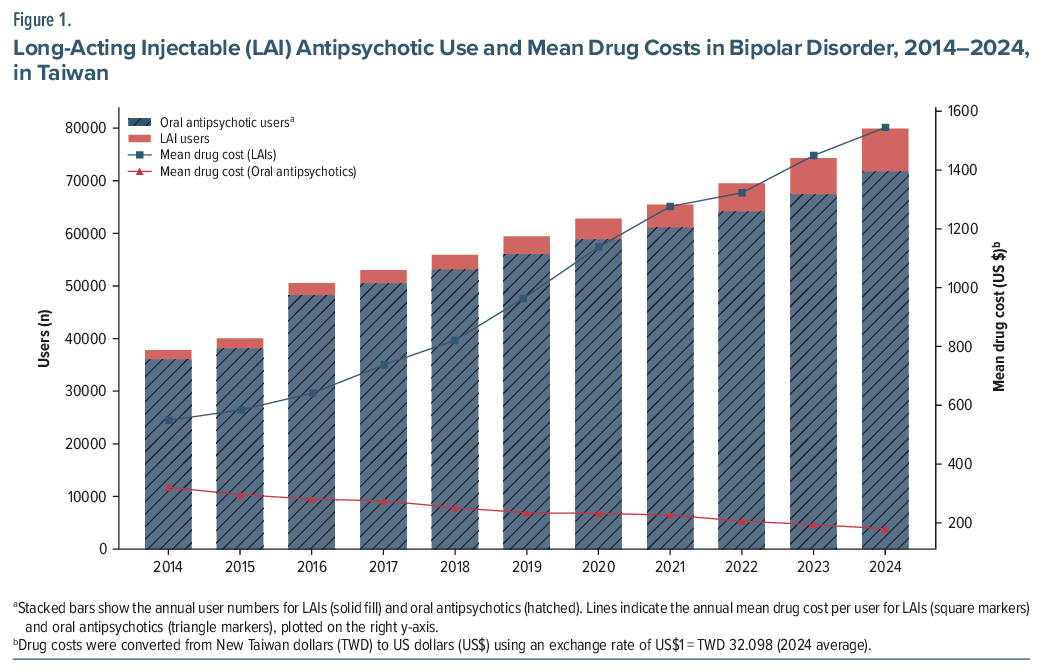
Between 2014 and 2024, the number of patients with BD receiving antipsychotic treatment increased steadily. The number of oral antipsychotic users increased from 36,008 to 71,750, and LAI users increased from 1,807 to 8,179. Notably, more rapid growth of LAI users was observed from 2022–2024 (increases of +983, +1,565, and +1,216 users per year, respectively) (Figure 1). Consequently, the proportion of LAI users among all treated users (LAI plus oral) increased from 4.8% in 2014 to 10.2% in 2024. Over this period, growth in LAI use was driven primarily by SGA-LAIs, as the number of SGA-LAI users increased from 1,048 in 2014 to 7,709 in 2024 (≈7.4-fold). Meanwhile, first-generation LAI (FGA-LAI) use declined from 2014 to 2024, and the share of SGA-LAI users among all LAI users rose from 55.7% to 91.2%. Mean drug costs increased for LAIs overall (from US$548 to US$1,544) but decreased for oral antipsychotics (from US$322 to US$178). Among LAIs, mean drug costs increased markedly for SGA-LAIs (from US$904 to US$1,635), whereas mean costs for FGA-LAIs remained comparatively low and stable at approximately US$51–59 through 2023 (a decline to US$37 was observed in 2024). In our study cohort, the groups were comparable in terms of sex distribution (approximately 47% male) and age (mean ≈41–42 years).
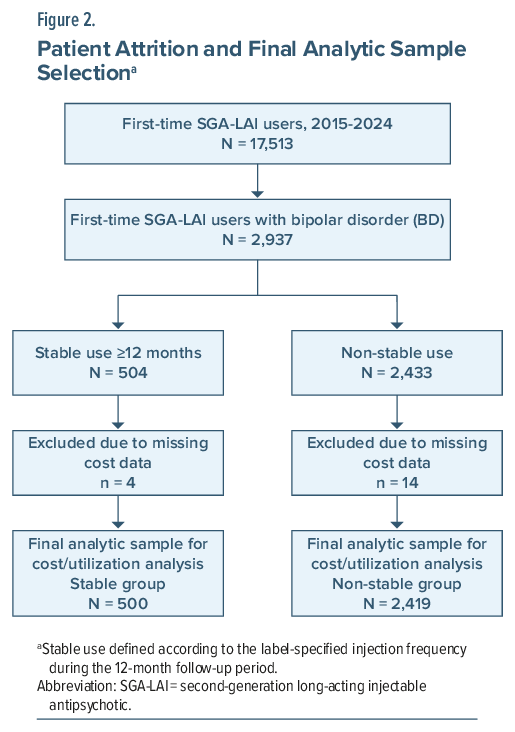
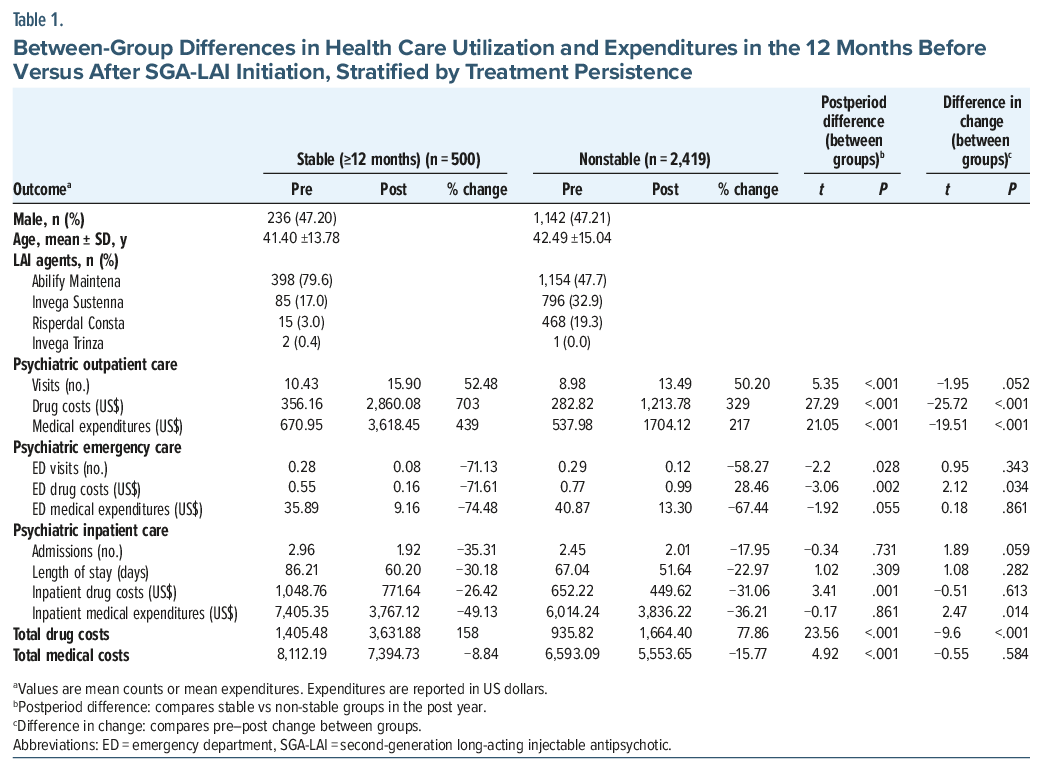
Using the NHI data, we identified all individuals who initiated a reimbursed SGA-LAI for the first time during the study period (index cohort; n = 17,513). Then, we restricted the analytic sample to BD initiators, yielding 2,937 first-time SGA-LAI users with BD. Next, we classified BD initiators as stable-use or non-stable-use based on persistence. After excluding 18 patients with missing health care expenditure data, including 4 patients in the stable-use group and 14 patients in the non-stable-use group, the final analyses of health care utilization and expenditures included 500 stable users and 2,419 non-stable users (Figure 2). The distribution of LAI agents is presented in Table 1. Patients treated with Abilify Maintena accounted for a higher proportion of the stable-use group, whereas Invega Sustenna and Risperdal Consta accounted for higher proportions of the non-stable-use group. In the final analytic sample, 236 patients (47.20%) in the stable-use group and 1,142 patients (47.21%) in the non-stable-use group were male, with no significant between-group difference (χ2 < 0.001, P = .997). The mean age was 41.40±13.78 years in the stable-use group and 42.49±15.04 years in the non-stable-use group, with no significant between-group difference (t = 1.59, P = .11).
Psychiatric Health Care Utilization and Expenditures in the 12 Months Before Versus After SGA-LAI Initiation
In the mirror-image analysis comparing the 12 months before and after SGA-LAI initiation, both stable users (≥12 months label-frequency-concordant use; n=500) and non-stable users (n = 2,419) showed increased outpatient engagement but reduced acute-care utilization. Table 1 summarizes the analysis results. Among stable users, mean psychiatric outpatient visits increased from 10.43 to 15.90 (P < .001). Marked increases in outpatient drug costs (US$356.16 to US$2,860.08; P < .001) and outpatient medical expenditures (US$670.95 to US$3,618.45; P < .001) were also observed for this group. In contrast, psychiatric ED utilization decreased (visits 0.28 to 0.08; P < .001), with corresponding reductions in ED drug costs (US$0.55 to US$0.16; P < .001) and ED medical expenditures (US$35.89 to US$9.16; P < .001). Psychiatric inpatient use also declined in stable users, as admissions decreased from 2.96 to 1.92 (P < .001) and LOS from 86.21 to 60.20 days (P = .0048). As expected, these changes were accompanied by lower inpatient drug costs (US$1,048.76 to US$771.64; P= .053) and inpatient medical expenditures (US$7,405.35 to US$3,767.12; P < .001).
Similar patterns were observed among non-stable users, with increases in outpatient visits (8.98 to 13.49; P < .001), outpatient drug costs (US$282.82 to US$1,213.78; P < .001), and outpatient medical expenditures (US$537.98 to US$1,704.12; P < .001). Concordantly, non-stable users had reductions in ED visits (0.29 to 0.12; P < .001) and ED medical expenditures (US$40.87 to US$13.30; P < .001), but ED drug costs were low and did not significantly change (US$0.77 to US$0.99). Inpatient admissions (2.45 to 2.01; P = .006), LOS (67.04 to 51.64 days; P < .001), inpatient drug costs (US$652.22 to US$449.62; P < .001), and inpatient medical expenditures (US$6,014.24 to US$3,836.22; P < .001) all decreased after initiation in non-stable users.
Total drug costs in the stable-use group increased from an average of US$1,405.48 in the preindex year to US$3,631.88 in the postindex year, and this increase was statistically significant (P < .001). In the non-stable-use group, total drug costs increased from US$935.82 to US$1,664.40, and this increase was also statistically significant (P < .001). The between-group difference in the change in total drug costs was statistically significant (P < .001). Total medical costs in the stable-use group decreased from an average of US$8,112.19 in the preindex year to US$7,394.73 in the postindex year, but this difference did not reach statistical significance (P =.188). In the non-stable-use group, total medical costs decreased from US$6,593.09 to US$5,553.65, and this reduction was statistically significant (P < .001). The between-group difference in the change in total medical costs was not statistically significant (P = .584). Some components of the shift toward outpatient care were more pronounced among stable users, particularly outpatient expenditures and inpatient medical expenditures; however, between-group differences were not significant for ED visits, admissions, or length of stay. This pattern is best interpreted as an implementation-related signal of continued engagement with injection-based care, rather than as direct evidence that stable users derived greater intrinsic pharmacologic benefit from LAIs. As a sensitivity analysis, the ±30-day index window was excluded. The patterns in outpatient and emergency care remained similar to the original patterns for both stable and non-stable users. However, the apparent reductions in inpatient utilization among non-stable users in the primary analysis were not robust to exclusion of the ±30-day index window; after exclusion, inpatient admissions, length of stay, and inpatient expenditures increased during the postindex period (Supplementary Table 1).
DISCUSSION
Consistent with international trends, the number of patients with BD receiving antipsychotic treatment increased steadily from 2014 to 2024, alongside a progressive shift toward long-acting formulations. It has been previously suggested that these trends are likely due to multiple contributing factors.19–21 A key observation in our cohort was that psychiatric ED visits, inpatient admissions, and LOS all decreased in the 12 months after initiation of LAIs, whereas outpatient encounters and outpatient drug/medical expenditures increased. Although stable users showed numerically larger reductions in several acute-care measures, statistically significant between-group differences in pre–post change were limited to selected expenditure outcomes and were not observed for ED visits, inpatient admissions, or length of stay.
Our findings suggest that, within Taiwan’s single-payer NHI system, LAI initiation may facilitate continuity of care in BD by shifting service use from acute settings toward planned ambulatory follow-up. From a payer perspective, this shift from inpatient and emergency care toward ambulatory follow-up should be interpreted together with changes in drug expenditures. Although inpatient and ED utilization declined after SGA-LAI initiation, outpatient drug expenditures increased substantially, particularly among stable users. In our analysis, total medical costs decreased numerically among stable users but did not reach statistical significance, whereas non-stable users showed a statistically significant reduction in total medical costs. Moreover, the between-group difference in total medical cost change was not significant, while the change in total drug costs differed significantly between groups. These findings suggest that reduced acute-care utilization does not necessarily translate into clear short-term total cost savings and that cost offsets should be interpreted cautiously within a single-payer system. After initiation, both stable and non-stable users showed increased psychiatric outpatient engagement together with reduced emergency department use and inpatient utilization. Because LAIs require regularly scheduled administration, they may create recurring points of clinical contact that support monitoring, reinforce treatment continuity, and allow earlier intervention before crises escalate to emergency or inpatient care. In this sense, the observed postinitiation pattern may reflect not only medication exposure itself but also a care-delivery mechanism through which LAIs help structure ongoing contact with services.
The mirror-image design has inherent limitations. Because each patient serves as their own control, pre–post comparisons cannot fully separate the pharmacologic effects of LAIs from temporal influences or the natural course of illness. LAIs are frequently initiated during or shortly after clinical deterioration, hospitalization, or symptomatic relapse. Such events are often followed by spontaneous improvement independent of treatment. This phenomenon, known as index-event bias,22 can contribute to an apparent decline in hospitalizations or emergency department (ED) visits during the follow-up period even in the absence of a true medication effect. Similarly, regression to the mean23 and intensified clinical monitoring immediately after treatment initiation may artificially amplify pre–post differences. Although we did observe substantial reductions in inpatient and ED utilization, these findings should be interpreted as associations, not definitive evidence of causal benefit.
The comparison between stable and non-stable users should be interpreted cautiously. In the present study, stable use was not intended to represent superior medication efficacy. Rather, it serves as an implementation-relevant indicator of sustained, label-frequency-concordant participation in LAI-based care. Patients who remained on scheduled injections for 12 months may differ from those who discontinued earlier in several clinically important ways, including baseline illness stability, treatment acceptability, family or service support, logistical feasibility, and willingness to remain engaged in care. Accordingly, the larger reductions in acute-care utilization observed among stable users are better understood as reflecting a more durable continuity-of-care pathway than as evidence of greater intrinsic pharmacologic benefit.
Taken together, these patterns are consistent with the possibility that LAI initiation supports a more structured pathway of care within Taiwan’s NHI framework. Regularly scheduled injection visits may increase outpatient contact, strengthen monitoring, and create opportunities for earlier intervention before deterioration leads to ED visits or hospitalization. This interpretation is concordant with prior international studies showing that LAIs can be associated with greater continuity of care and lower acute-care utilization over time.24 In the present study, less relapse-related service use may be inferred from these utilization patterns, but relapse was not directly measured.
From an implementation perspective, the relatively modest proportion of patients who maintained label-frequency-concordant LAI treatment over 12 months is itself an important finding. Persistence should not be interpreted here as an efficacy surrogate but rather as a practical indicator of whether LAI-based care can be sustained in routine practice. Differences in persistence across LAI agents may therefore inform implementation strategy, including injection interval, visit burden, and the feasibility of maintaining long-term engagement. Agent-specific differences in persistence should be interpreted as implementation-related patterns rather than comparative efficacy between LAI formulations. However, the claims data did not include information on changes in reimbursement criteria, market availability, institutional prescribing practices, or clinician and patient preferences; therefore, the factors underlying agent-specific differences in persistence could not be determined.
Several limitations should be considered when interpreting these findings. First, although the mirror-image design allows each patient to serve as their own control and provides useful within-person comparisons in routine clinical practice, this design is inherently vulnerable to temporal bias. It cannot fully disentangle the effects of LAI treatment from the natural course of illness, changes in clinical status over time, or the clinical circumstances that prompted LAI initiation. In real-world practice, LAIs are often initiated during or shortly after clinical deterioration, hospitalization, relapse, or a period of poor adherence. As a result, health care utilization during the preindex year may be elevated because of the index event itself, and subsequent reductions in ED visits, hospital admissions, or LOS may partly reflect index-event bias, regression to the mean, spontaneous improvement after an acute clinical crisis, or intensified clinical monitoring following LAI initiation. Therefore, the observed reductions in acute-care utilization after LAI initiation should be interpreted as associations between LAI initiation and subsequent health care resource utilization patterns, rather than as definitive evidence of a causal pharmacologic effect. Similarly, differences between stable and non-stable users should not be interpreted as evidence that one LAI agent, or one persistence group, had superior intrinsic pharmacologic efficacy. In the present study, stable use is better understood as an implementation-related marker of sustained engagement in an LAI-based care pathway, which may include more regular outpatient contact, symptom monitoring, medication counseling, family involvement, and psychosocial or social-work support. Second, the claims-based nature of the NHI data limited our ability to assess clinical severity, symptom trajectories, functional outcomes, patient preferences, family support, and psychosocial interventions. In this context, while LAIs may function as a care-delivery mechanism rather than solely as a drug formulation—where regularly scheduled injection visits increase opportunities for symptom monitoring, adverse-effect assessment, medication counseling, family communication, psychosocial support, and social-work referral—the NHI claims data did not allow us to determine whether individual injection visits were indeed accompanied by psychotherapy, social-work intervention, or family-based intervention. Consequently, changes in health care resource utilization should not be interpreted as direct evidence of improved clinical outcomes. In addition, the broader implications for cost-effectiveness, long-term functioning, and mortality cannot be inferred from the present analysis. The observed “shift from acute care toward ambulatory follow-up” may partly reflect improved engagement with the overall pharmacologic regimen and outpatient care, rather than the isolated pharmacologic effect of the LAI itself. Future studies should further incorporate oral antipsychotics and mood stabilizers as time-varying covariates to better disentangle the contribution of LAI treatment from concomitant medication use. Future studies using prospective designs, matched comparison groups, time-varying medication data, and symptom-level assessments are needed to better distinguish medication effects from confounding influences and to provide a more rigorous evaluation of the role of LAI-based care in BD management.
This nationwide mirror-image study suggests that, within Taiwan’s single-payer NHI system, SGA-LAI initiation in BD may facilitate continuity of care by shifting psychiatric service use from emergency and inpatient settings toward ambulatory follow-up. Sustained, label-frequency-concordant use was associated with a more pronounced version of this pattern but should be interpreted as an implementation-related indicator of continued engagement with LAI-based care rather than as a surrogate for superior drug efficacy. These findings support the pragmatic role of LAIs as a continuity-of-care strategy in BD and warrant stronger study designs to test causal effects on clinical outcomes. Less relapse-related service use may be inferred from reduced acute-care utilization, but relapse was not directly measured.
Article Information
Published Online: October 21, 2026. https://doi.org/10.4088/JCP.26m16479
© 2026 Physicians Postgraduate Press, Inc.
Submitted: April 14, 2026; accepted August 25, 2026.
To Cite: Hsieh TY, Tsai PL, Huang CY, et al. From hospital to outpatient care after long-acting injectable antipsychotic initiation in bipolar disorder: nationwide evidence from Taiwan. J Clin Psychiatry 2026;87(4):26m16479.
Author Affiliations: National Health Insurance Administration-Southern Division, Ministry of Health and Welfare, Tainan, Taiwan (Hsieh, Jiang, Yang, Chien); Department of Counseling, National Chiayi University, Chiayi, Taiwan (Hsieh); Institute of Clinical Pharmacy and Pharmaceutical Sciences, College of Medicine, National Cheng Kung University, Tainan, Taiwan (Tsai, Chang); Department of Community Psychiatry, Bali Psychiatric Center, Ministry of Health and Welfare, New Taipei City, Taiwan (Huang); School of Pharmacy, College of Medicine, National Cheng Kung University, Tainan, Taiwan (Chang); Department of Pharmacy, National Cheng Kung University Hospital, College of Medicine, National Cheng Kung University, Tainan, Taiwan (Chang); Department of Pharmacy, National Cheng Kung University Hospital, Dou-Liou Branch, Yunlin, Taiwan (Chang); Department of Psychiatry, National Cheng Kung University Hospital, College of Medicine, National Cheng Kung University, Tainan, Taiwan (Chen).
Corresponding Author: Po See Chen, MD, PhD, Department of Psychiatry, National Cheng Kung University Hospital, 138 Sheng Li Road, North Dist., Tainan 70403, Taiwan ([email protected]).
Author Contributions: Conceptualization: (Hsieh); software: (Hsieh); data curation: (Hsieh, Jiang, Yang, Chien); formal analysis: (Hsieh, Tsai); methodology: (Tsai, Jiang, Yang, Chien); writing—review & editing: (Huang, Chang, Chen); writing—original draft: (Chen); supervision: (Chen).
Financial Disclosures: The authors declare no financial relationships with commercial entities and gratefully acknowledge the research participants for their valuable involvement.
Funding/Support: This research did not receive any specific grant from funding agencies in the public, commercial, or not-for-profit sectors.
Data Availability: The data supporting our observational study were obtained from the National Health Insurance Database. According to the Taiwanese “Personal Information Protection Act” and governmental regulations, data with individual information cannot be released. The authors may provide aggregated data without individual information upon reasonable request.
Acknowledgments: The authors extend their sincere gratitude to the Department of Psychiatry at National Cheng Kung University Hospital for their invaluable support and resources throughout this research project.
Supplementary Material: Available at Psychiatrist.com.
Clinical Points
- Second-generation long-acting injectable antipsychotic initiation in bipolar disorder was associated with less acute-care use and greater engagement in planned outpatient care.
- Scheduled injection visits may promote clinical monitoring and continuity of care beyond medication delivery alone.
- Stable use reflects sustained engagement with long-acting injectable–based care and should not be interpreted as head-to-head evidence of superior pharmacologic efficacy.
Journal of Clinical Psychiatry, all rights reserved.
Recent Posts
Apogem Capital Leads Minority Investment in Family Care Center
Laura Lovett | October 21, 2026
Do Psychedelics Need a Rebrand Before Their Approval for Mental Health?
Ashleigh Hollowell | October 21, 2026
Virginia mental health provider to settle Medicaid billing allegations for $1.8M
Ella Ruder | October 21, 2026
Covenant Health taps behavioral health VP
Ella Ruder | October 21, 2026
Ketamine drugmakers seek FDA approval as providers raise concerns: 5 things to know
Ella Ruder | October 21, 2026
Integrated Psychiatric Consultants
Office Hours:Mon-Fri, 9 a.m. - 5 p.m. CT