
Original Source: Journal of Clinical Psychiatry, all rights reserved. —
Depression, the most predominant mood state of bipolar disorder (BD), is associated with treatment resistance, functional disability, and suicidality.1 Despite illness predominance, in comparison to acute mania and bipolar maintenance phase treatment with 11 and 8 FDA-approved drugs respectively, and compared to major depressive disorder (MDD; 25+ FDA approvals), bipolar depression has only 5 FDA-approved treatments.2 All are antipsychotics, used either as monotherapy (cariprazine, lumateperone, lurasidone, and quetiapine) or in combination with a selective serotonin reuptake inhibitor (olanzapine-fluoxetine combination). While antidepressant monotherapy continues to be highly utilized,3,4 outside of olanzapine-fluoxetine combination, there are no unimodal, non–mood-stabilizing agents FDA-approved for bipolar depression.
An estimated 20%–50% of bipolar patients suffer from persistent subsyndromal or residual depressive symptoms interepisodically.5 These residual symptoms, even at mild-to-moderate levels, drive functional impairment across work, social, and cognitive domains.6 Depression, including subsyndromal depression, is a strong correlate of functional impairment in BD across all domains.7 Subsyndromal depressive symptoms are approximately 3-fold more common than major depressive and manic symptoms in both bipolar disorder type I (BD-I) and type II (BD-II).7,8 Critically, residual symptoms indicate that the individual is still at significant risk for relapse and/or recurrence, with nearly a 3 times higher risk compared to those achieving asymptomatic recovery.9
Mixed d-amphetamine/l-amphetamine salt (MAS) is an FDA-approved stimulant for attention-deficit/hyperactivity disorder (ADHD) in adults and adolescents.10–12 The drug is believed to disrupt the vesicular monoamine transporter-2 (VMAT2) and block the presynaptic dopamine (DAT) and norepinephrine (NET) transporters,13 increasing synaptic intra-and extracellular accumulation of both monoamines, respectively.14,15 Amphetamine derivatives additionally inhibit monoamine oxidase activity, decreasing cytosolic monoamine breakdown.16 This contrasts with methylphenidate, which primarily increases extracellular dopamine and norepinephrine by blocking DAT and NET.17 The amphetamine multimodal mechanism of action (VMAT2, DAT, NET, MAOI) may result in a more robust increase in monoamines,14,18 aligning with the clinical impact of amphetamine being associated with a higher ADHD response rate, compared to methylphenidate, in children, adolescents,19 and adults,20 as well as an increased relative risk of treatment-emergent psychosis (methylphenidate 0.10%, amphetamine 0.21%).21 Given significant care gaps in bipolar depression, this study investigated the safety and efficacy of a mixed d-amphetamine/l-amphetamine in adults with bipolar depression.
METHODS
General Procedures
Study sites included Mayo Clinic (Rochester and Austin, Minnesota) and the Lindner Center of HOPE/University of Cincinnati, each with respective protocol approved by their local institutional review board (Mayo IRB: 19-001722; Lindner Center of Hope IRB: 2020-0249). Adult patients (18-65 years old) with BD-I or BD-II were included. Recruitment was from November 3, 2020, through March 24, 2025 (ClinicalTrials.gov identifier: NCT04235686).
The study design was based on earlier work by McElroy et al, 2015, investigating adjunctive lisdexamfetamine (LDX), FDA-approved for ADHD, in an 8-week, randomized, double-blind, controlled trial in 25 patients with bipolar depression.22 Although LDX did not demonstrate superiority over placebo on the primary outcome, Montgomery-Asberg Depression Rating Scale (MADRS), it was associated with significant improvement in self-reported depressive symptoms without emergent mania. Premature study termination was directed by the funding sponsor following the failure of the phase 3 LDX program in MDD.22
Participants signed written informed consent, received study medication free of charge, and were remunerated up to $415 in the form of checks mailed to their home if they completed all study aspects. The 8-week, randomized, double blind, placebo-controlled study was followed by an 8-week open-label extension-trial phase of MAS.
Participants
Inclusion criteria allowed adults between 18 and 65 years old, with BD-I or BD-II disorder as confirmed by Structured Clinical Interview for DSM-IV-TR (SCID), symptom severity measured by the Quick Inventory of Depressive Symptomatology–Clinician-Rated (QIDS-C16 ≥9),23 and the Clinical Global Impression for Bipolar Disorder (CGI-BP ≥3) Depression Severity Scale.24 The inclusion criteria did allow for residual symptoms, recognizing that these mild symptoms themselves are associated with functional impairment7 and are often a harbinger of subsequent depressive relapse.25 Stable mood stabilization for ≥2 weeks (eg, lithium, anticonvulsant and/or atypical antipsychotic) was required for BD-I and BD-II. Participants were permitted to receive lamotrigine as their mood-stabilizing regimen, with or without concomitant antidepressants. Adjunctive antidepressants were allowed. Patients on stimulants for comorbid ADHD and/or binge eating disorder could be enrolled, provided that the stimulant was tapered and discontinued ≥1 week before randomization. Patients with a prescribed opiate or other pain intervention were allowed, provided that the prescribed opiate was at recommendation dose without evidence of use disorder by SCID or prescription misuse.
Exclusion criteria included inability to provide written consent, inability to understand English or study objectives based on comprehension assessment, current hypomania measured by the Young Mania Rating Scale (YMRS ≥12),26 active psychosis (YMRS >4 on question 8), primary psychotic disorder by SCID, suicidality (response of >2 on question 12 of QIDS-C, response=3 on the SCID Module-A), or medically serious suicide attempt within 6 months. Drug-use exclusion criteria included SCID-confirmed active alcohol, opiate, or cannabis use disorders (participants meeting full remission ≥3 months were allowed), lifetime history of cocaine or methamphetamine abuse or dependence, positive toxicology screen for drugs of abuse, active stimulant prescription abuse or dependence, and lifetime history of stimulant-induced mania. Participants using cannabis for recreational purposes who failed the initial toxicology screen were allowed if the Cannabis Use Disorders Identification Test-Revised score was <12, not suggestive of hazardous, problematic, or potential cannabis use disorder.27 Psychiatric comorbidities of the study participants are detailed in Supplementary Table 1.
Additional exclusion criteria included hypersensitivity to amphetamines or other ingredients of Mydayis, clinically unstable medical disease, or laboratory abnormality (detailed in Supplementary Table 2), pregnancy, lactation, and daily use of lorazepam at doses >2 mg/d or dose-equivalent benzodiazepines. Participants who discontinued the double-blind phase for symptom worsening and were not administratively discharged were eligible to enter the open-label extension (Supplementary Figure 1; CONSORT diagram).
Study Measures
The primary outcome measure was baseline-to-end point change in depression, measured by the MADRS.28 Secondary outcomes were percentage of subjects achieving remission (MADRS <10) and response rate (≥50% reduction in MADRS), percentage of participants achieving much or very much improvement on the CGI-BP, and baseline-to-end point change in both QIDS-C and Quick Inventory of Depressive Symptomatology–Self-Report (QIDS-SR).29 The primary safety assessment was the YMRS, quantified for treatment-emergent hypomania (YMRS ≥12), mania (YMRS ≥20), or emergence of psychotic symptoms, measured by YMRS >4 on question 8 and clinical assessment. Assessment of suicidality and/or suicide behavior was conducted with the Columbia-Suicide Severity Rating Scale.30 Cognitive function was tested with the Digit Symbol Substitution Test (DSST) assessing speed, memory, and visual scanning.31 Fatigue severity and Sleepiness were assessed with the Fatigue Severity Scale (FSS)32 and Epworth Sleepiness Scale (ESS), respectively.33 The self-reported Compliance Assessment (CA) scale was used to generate a Treatment Adherence Score (TAS). A TAS score of 1 indicated that the participant never missed medication, while a score of 2 indicated infrequent missed doses with ≥75% of the prescribed dose taken. This operational definition is consistent with the adherence threshold commonly used in clinical research.34
Study Medication
Participants were randomly assigned (1:1) to receive MAS (Mydayis; d-amphetamine/l-amphetamine) or placebo under double-blind conditions. Study medication was dispensed at the initiation visit with standardized dosing instructions. Treatment assignment followed a prearranged randomization schedule, with drug dispensing handled by research personnel blinded to clinical outcome assessments. Active treatment consisted of Mydayis, an extended-release mixed-amphetamine-salts formulation; placebo capsules were color-and appearance-matched and identically packaged. The study treatment was administered in 12.5-and 25-mg capsules and titrated to a maximum of 50 mg/d: 12.5 mg/d for 7 days, 25 mg/d for 7 days, 37.5 mg/d for 14 days, and 50 mg/d for 28 days. Dose adjustments were permitted based on tolerability and/or early clinical response. All participants entering the open-label phase, regardless of blind assignment, restarted at 12.5 mg for 7 days.
Statistical Power and Data Analysis
Sample size calculations followed McElroy et al,22 who assumed a conservative effect size of d = 0.85 based on prior pramipexole trials in bipolar depression.35,36 Using a 2-sample t test (α = .05, power = 0.80), this yielded a target of 23 participants per group (N = 46). The current study enrolled only 32 participants and closed enrollment at the end of the funding period; post hoc power analysis confirmed that this sample size retained 80% power to detect effects of d ≥1.03.
Baseline characteristics were summarized descriptively and compared between MAS and placebo using Fisher exact tests for categorical variables and Kruskal-Wallis tests for continuous variables. Double-blind phase efficacy outcomes were evaluated as change from baseline (last observation used), with continuous measures (MADRS, QIDS-C/SR, ESS, FSS) assessed as percent change (percent reduction if lower is better) and categorical outcomes (remission [MADRS <10], response [≥50% reduction in MADRS], much or very much improved on CGI-BP improvement) defined categorically. Standardized effect sizes (Cohen d) were derived from age-adjusted multivariable models. For binary outcomes, odds ratios (ORs) were converted to d using the Hasselblad and Hedges (1995) method37; continuous outcomes used pairwise differences divided by the residual standard deviation. Magnitudes were interpreted via Cohen’s (1988) benchmarks (eg, d≥0.8 as “large”).37,38 Safety outcomes at blind-phase and open-phase (YMRS only) end points included YMRS, systolic and diastolic blood pressure, pulse, and BMI, adjusted for baseline (week 0) levels and age.
Longitudinal treatment effects were assessed with linear mixed-effects models. In the double-blind phase, MADRS, QIDS-C, and QIDS-SR were modeled with fixed effects for treatment, categorical time, their interaction, baseline adjustment, and a participant-level random intercept. Open-label models estimated MADRS from week 8 (open-label baseline) by prior treatment group, modeling time categorically or continuously and adjusting for age. One set of models used only the baseline and end point scores; the other used all time points.
Binary outcomes are presented as model-based predicted probabilities, while continuous and count outcomes are reported as means or inverse-link means. Effect sizes are expressed as ORs for logistic regression models, mean differences for linear models, and incidence rate ratios for negative binomial models.
Because no dedicated ADHD or attention rating scale was administered, an exploratory analysis used 2 depression-scale items indexing attention/concentration as the closest available proxies: MADRS item 6 (concentration difficulties) and QIDS item 10 (concentration and decision-making). Two post hoc analyses were conducted in all randomized participants using each participant’s last available observation. First, end point concentration-item severity was modeled with ordinal (proportional-odds) logistic regression adjusted for baseline item score and age. To address sparse end point cells, both items were collapsed to 3 ordered levels (MADRS: 0, 1–2, ≥3; QIDS: 0, 1, 2–3). The MADRS grouping was driven by end point sparsity, all odd-level MADRS levels contained n≤3, and no scores of 6 were observed, and is consistent with the items anchoring structure, in which even scores are anchored and odd scores represent unanchored intermediate ratings. Second, CGI-BP improvement was modeled by logistic regression adjusted for age and either (i) change in the concentration item alone or (ii) change in the concentration item plus change in total MADRS, distinguishing whether treatment-associated global improvement reflected change in attention specifically or overall depressive change.
Completion of the double-blind and open-label phases was compared between arms using Fisher exact test. Robustness of the primary MADRS percent-reduction outcome to differential attrition was assessed through prespecified completer and depression-related-exclusion analyses and through multiple imputation with a delta-adjusted sensitivity analysis (Supplementary Methods). All statistical tests were 2-tailed with a significance level of α = .05.
RESULTS
Demographic Variables and Baseline Characteristics
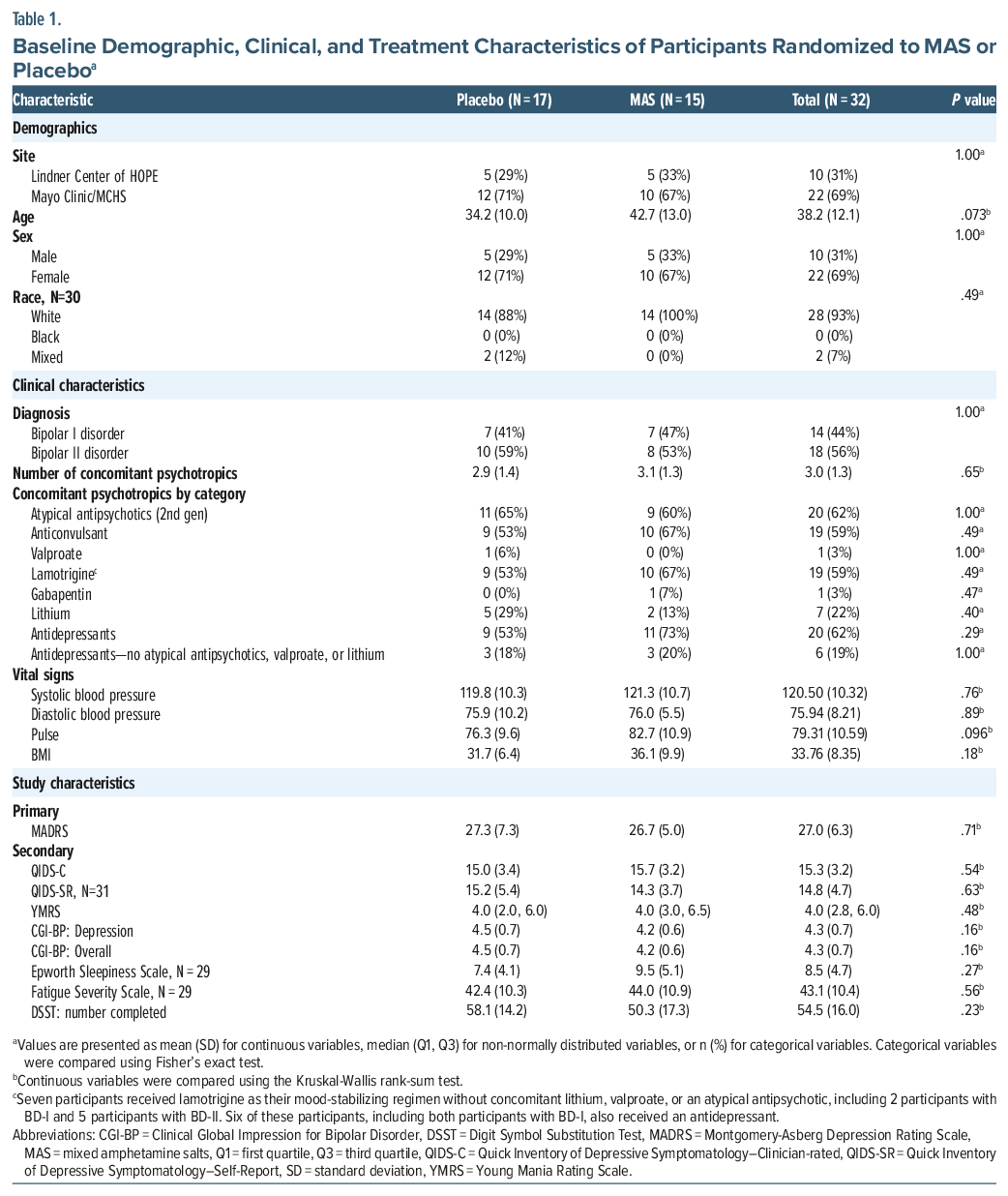
Participants (N = 32) included patients with BP-I (n = 14) and BP-II (n = 18) disorder. Mean age was 38.2 years; 10 (31%) were male, and 22 (69%) were female. Baseline symptom severity (MADRS = 27.0±6.3; QIDS-C = 15.3±3.2; QIDS-SR = 14.8±4.7; YMRS median = 4.0 [interquartile range = 2.75–6.00]) was consistent with moderate depression and absence of hypomania. No participants were on stimulants or opiates at baseline. The most common concomitant psychotropics were atypical antipsychotics and antidepressants (each 20/32, 62%), followed by anticonvulsants (59%), which were almost entirely lamotrigine (19/32, 59%); valproate (3%) and gabapentin (3%) were infrequent. Seven participants were taking lithium (22%). Seven participants received lamotrigine as their only mood stabilizer (ie, without lithium, valproate, or an atypical antipsychotic), including 2 participants with BD-I and 5 participants with BD-II. During the blind phase, 17 participants were assigned to placebo and 15 to MAS. There were no significant differences between groups in baseline demographics, concomitant medications, or number of psychotropics used (Table 1).
Outcomes
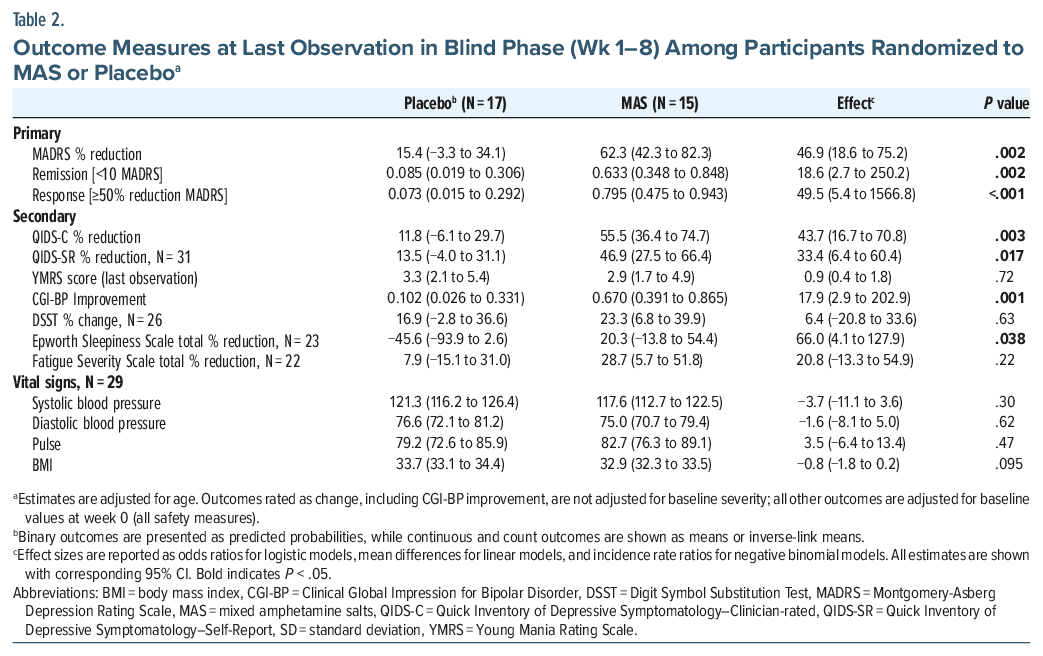
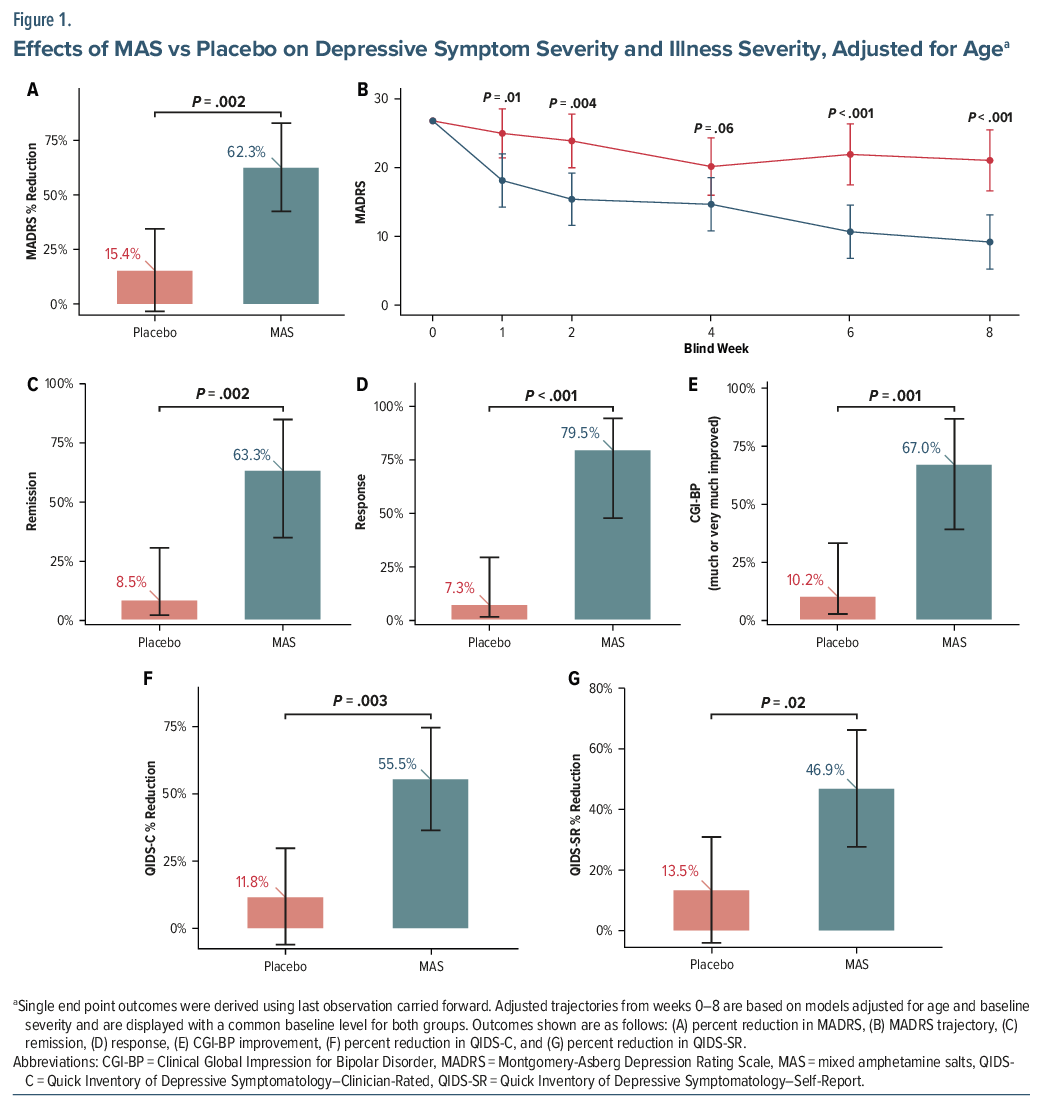
Blind phase. Participants receiving MAS showed significantly greater improvement in depressive symptoms on the MADRS than those receiving placebo after adjusting for age, with mean percent reductions of 62.3% versus 15.4%, respectively (P =.002) (Table 2, Figure 1A), corresponding to a large effect size (Cohen d = 1.28). Between-group differences (Figure 1B) were evident as early as week 1 and sustained through week 8 (P≤.01 at most visits). Remission (MADRS<10) was significantly higher with MAS than with placebo (63.3% vs 8.5%; OR = 18.6, 95% CI 2.7-250.2; P=.002; Figure 1C). Response (≥50% reduction in MADRS) occurred more frequently with MAS than with placebo (79.5% vs 7.3%; OR = 49.5, 95% CI 5.4-1,566.8; P<.001; Figure 1D).
Secondary Outcomes
MAS was also associated with greater improvement on depressive symptom secondary scales, with larger percent reductions on the QIDS-C (55.5% vs 11.8%; P = .003) and the QIDS-SR (46.9% vs 13.5%; P = .017) (Table 2; Figure 1F and 1G).
MAS had higher odds of being rated as much or very much improved on the CGI-BP than placebo after adjusting for age (67.0% vs 10.2%; P = .001; Figure 1E). MAS was associated with a larger percent reduction on the ESS (20.3% vs −45.6% with placebo; P = .038), whereas percent reductions on the FSS (28.7% vs 7.9%; P = .22) and percent change on the DSST (23.3% vs 16.9%; P = .63) did not differ significantly between groups.
Exploratory Post hoc and Sensitivity Analysis
In ordinal models of end point concentration-item severity adjusted for baseline item score and age, MAS was not significantly associated with either the MADRS concentration item (OR 0.18, 95% CI 0.03-1.06, P = .058) or the QIDS concentration/decision-making item (OR 0.50, 95% CI 0.10-2.60, P = .41; Supplementary Table 3). In logistic models of CGI-BP improvement adjusted for age and change in a single concentration item, the treatment effect was large and significant (MADRS item-adjusted OR 18.2, 95% CI 2.42-136.7, P = .001; QIDS item-adjusted OR 23.7, 95% CI 2.08-269.3, P = .003). After additionally adjusting for change in total MADRS, the treatment effect was fully attenuated (OR 0.75, P = .88 and OR 1.61, P = .77, respectively), whereas change in total MADRS remained associated with improvement, with greater worsening predicting lower odds of improvement (OR 0.69, 95% CI 0.52-0.91, P = .001; OR 0.76, 95% CI 0.60-0.97, P= .009). Neither concentration item retained an independent association (ΔMADRS item P= .51; ΔQIDS item P =.60). Considered alone, the QIDS concentration item was associated with improvement (OR 0.15, 95% CI 0.03-0.80, P= .01) (Supplementary Table 4).
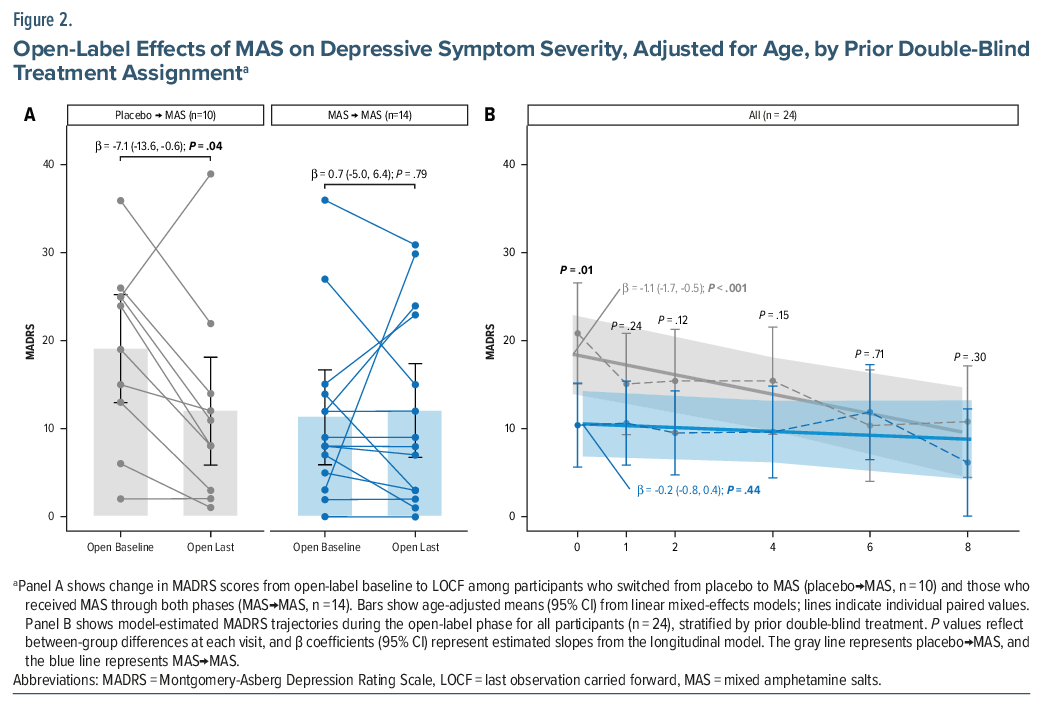
Open-label phase. During the open-label phase (n=24) (Figure 2A), participants who switched from blind placebo to open-label MAS (n = 10) showed a significant reduction in MADRS from open-label baseline to end point (P = .04). Participants who switched from blind MAS to open-label MAS (n = 14) maintained stable MADRS scores over the open-label period (P = .79). Longitudinal modeling of open-label MADRS trajectories for all participants (n = 24; Figure 2B) demonstrated a significant overall decline in depressive symptoms among those previously assigned to placebo (β = −1.11 points/week; 95% CI −1.72 to −0.50; P < .001), whereas no significant slope was observed among participants previously treated with MAS (β = −0.23; 95% CI −0.81 to 0.35; P = .44).
Safety Outcomes
Adjusted analyses showed no significant group differences in last-observed YMRS scores during the blind phase (2.9 vs 3.3; rate ratio = 0.9, 95% CI 0.4-1.8; P = .72). No significant differences were observed for systolic or diastolic blood pressure, pulse, or BMI, although a trend toward lower BMI was observed in the treatment group (P = .095). In the open phase (n = 24), participants who continued MAS from the blinded phase (weeks 1–16) had higher YMRS last-observation scores than those who had received placebo and initiated MAS during the open-label extension weeks 9–16 (5.0 vs 1.2; rate ratio =4.2, 95% CI 1.3-13.5; P=.015).
Treatment Exposure and Dose
In the double-blind phase, the final MAS dose was comparable between participants randomized to MAS or placebo (mean [SD]: 31.7 [14.1] mg vs 30.9 [15.4] mg; range 12.5–50 mg; P = .86). In the open-label phase, the final mean (SD) MAS dose (n = 24) was 26.6 (14.4) mg, with no significant differences by prior double-blind assignment (P = .62).
Retention and Medication Compliance
Overall, 68.8% of participants (22/32) completed the blind phase. Dropout was nonsignificantly higher in the placebo group (MAS 13.3% [2/15] vs placebo 47.1% [8/17], P = .06). In the MAS arm, discontinuations were due to gastrointestinal (GI) distress and migraine; in the placebo arm, reasons included c (n = 3), sinus tachycardia (n = 1), increased systolic blood pressure (n = 1), steroid treatment initiation (n = 1), loss to follow-up (n = 1), and increased anxiety (n = 1). Two participants (1 placebo, 1 MAS) did not complete the double-blind phase and subsequently initiated MAS during the open-label extension. Medication adherence, measured by the TAS, was high in the blind and open phases, with 91% (n = 29) and 88% (n = 21) of participants taking medications as prescribed or ≥75% of the time, respectively.
Of the 8 placebo withdrawals, 6 had their last available observation at or before week 2. Three placebo withdrawals were attributed to worsening depressive symptoms and 5 to reasons unrelated to depressive illness; in the MAS arm, the 2 discontinuations were for GI distress and migraine. Week-by-week counts of active participants and reasons for attrition in both phases are detailed in Supplementary Table 5. In the open-label extension, 7/10 (70%) of participants originally randomized to placebo and 7/14 (50%) originally randomized to MAS completed week 8, with no significant between-group difference (P = .42).
Attrition-Adjusted Treatment Effect Estimates
Because attrition was numerically greater and differently patterned in the placebo arm (with early, depression-related withdrawals), the primary estimate was re-examined across alternative analytic populations (Supplementary Table 6). The primary, age-adjusted treatment effect was 46.9% points (95% CI 18.6-75.2; P= .002). Restricting to blind-phase completers yielded 42.0% points (95% CI 20.8-63.3; P= .001), and excluding the 3 depression-related discontinuations yielded 38.5% points (95% CI 17.4-59.5; P= .001). Multiple imputation gave a pooled estimate of 39.1% points (95% CI 21.4-56.8; P<.001). Under delta-adjusted imputation penalizing the imputed reductions of depression-related withdrawals by 10 to 30 percentage points, the estimated treatment effect ranged from 40.9 to 44.6% points (all P<.001). The treatment effect was thus somewhat smaller under the models that do not use early placebo observations but remained large and statistically significant across all models (38-47 percentage points; all P≤.002).
Safety and Adverse Events
During the blind phase, 29/32 participants reported ≥1 adverse event (AE), and no serious adverse events (SAEs) occurred. The most frequent AE was headache (placebo n = 4, MAS n = 5). GI complaints included nausea (placebo n = 3, MAS n = 1), vomiting (placebo n=1, MAS n=3), indigestion (placebo n = 0, MAS n = 2), and diarrhea (placebo n = 2, MAS n = 1). Sleep-related symptoms included insomnia (placebo n = 0, MAS n = 2). Additional AEs, reported in ≥1 participant, included dry mouth, aches/pain, tremor/twitching, fatigue, tachycardia, increased blood pressure, and anxiety.
During the open phase, 18/24 participants reported ≥1 AE without SAEs. The most frequent AE included headache (n = 8), indigestion (n = 5), nausea (n = 3), diarrhea (n = 3), and vomiting (n = 2). Additional AEs in ≥1 participant included fatigue, distractibility inattention, anxiety, dry mouth, aches/pain, increased energy, increased blood pressure, and a rapid-onset rash. Study discontinuations due to AEs were attributed to worsening depression (n = 1), treatment-emergent mania (YMRS >20, n = 1), suspected drug misuse ( n= 2) due to unexplained medication accountability discrepancies (exceeding medication adherence by 2 doses and 5 doses, respectively, resulting in study administrative termination), irritability (n = 1), and GI sensitivity to plastic encapsulation (n = 1).
DISCUSSION
In this 8-week randomized, double-blind, placebo-controlled trial of adjunctive mixed amphetamine salts, MAS was superior to placebo in reducing symptom burden of depression as assessed by MADRS, with higher rates of remission and treatment response. These results align with prior systematic reviews demonstrating efficacy of dopaminergic agents (pramipexole, modafinil/armodafinil) in bipolar depression.39–42
Treatment-emergent mania is one of the main concerns for clinicians when considering stimulant therapy.43 A retrospective chart review of 137 patients (72% BD-I, 28% BD-II), with 43% of stimulant-treated patients on concurrent mood stabilizers, reported a rate of stimulant-associated mania/hypomania of 40%.44 The absence of mood destabilization in the blind phase of the current study is encouraging; however, the small sample size, careful selection criteria, and study duration may constrain our ability to fully characterize the risk of affective switch in potentially vulnerable subgroups. Viktorin et al45, using a large national registry (N = 2,307), identified an association between stimulant use and emergence of manic symptoms in patients without concurrent mood stabilizer in comparison to those with concurrent mood stabilization. Multiple systematic reviews demonstrated that psychostimulants, when used alongside mood stabilizers, do not precipitate treatment-emergent mania. However, 1 participant in the open-label phase of MAS, while on mood stabilization (aripiprazole and lamotrigine), in addition to bupropion, experienced treatment-emergent mania. While most clinical trials conducted in adolescent mania with treated co-occurring ADHD have shown the efficacy of atypical antipsychotics and mood stabilizers and safety of ongoing stimulant treatment, further investigation is encouraged to identify risk factors (antidepressant combination, inadequate mood stabilization, or comorbidity 44) for treatment-emergent mania.
Recent meta-analytic evidence suggests that amphetamines may carry a higher risk than methylphenidate for psychotic symptoms in ADHD populations (OR = 1.57), though bipolar-specific data remain limited.46,47 We did not observe emergence of psychotic symptoms in this study. Other safety concerns about using stimulants in BD include cardiovascular side effects, most notably in patients with preexisting, structural abnormalities increasing the possibility of myocardial infarction, stroke, and sudden death.48,49 Among older adults, a significant association of stimulant use and increased short-term risk (30 days) of ventricular arrhythmia or stroke was observed but was not sustained at 6 months or 1 year.50 Conversely, studies have suggested no evidence for an elevated risk of serious cardiovascular events among children and young people.51
Abuse liability is an important aspect to consider, as noted in our study, with 2/32 occurrences of misuse (6%). Abuse of stimulants is always a clinical concern due to the behavioral and psychological reinforcements associated with dopamine increase.52,53 In adult ADHD populations, some studies reported no stimulant misuse; in studies where misuse was present, self-reported prevalence ranged from 8.6% to 29%.54 Given the small sample size, the observed misuse rate should be interpreted cautiously; however, the findings support comprehensive risk stratification and ongoing monitoring for patients receiving stimulant therapy, particularly those with prior clinical instability or psychiatric comorbidity.
There was no difference in cognitive performance on the DSST. While stimulants consistently improve ADHD symptoms in BD, evidence for cognitive enhancement in non-ADHD BD populations remains mixed.55,56 A systematic review from the International Society for Bipolar Disorders cognitive taskforce (using objective neurocognitive measures) found limited evidence supporting cognitive benefits of ADHD medications in BD, with only 1 study showing trend-level improvements with modafinil.55 The current study may have been underpowered to detect cognitive effects, or amphetamine’s cognitive benefits may be more pronounced in specific subgroups. Consistently, sensitivity analysis showed that treatment was not significantly associated with end point severity on either concentration items on the MADRS or QIDS-C, and CGI-BP improvement persisted essentially unchanged after adjustment for change in these items yet was fully attenuated once overall depressive change was accounted for, suggesting a broad antidepressant effect rather than a selective procognitive or attentional one. These findings align with meta-analytic evidence that adjunctive psychostimulants and stimulant-like agents improve depressive outcomes in bipolar samples selected for depression rather than for ADHD.41 The small sample, imbalance in ADHD diagnosis between arms (Supplementary Table 1), and absence of an ADHD measure all contribute to a relative inability to determine independent attentional improvement with this stimulant in depression.
The current study has some limitations that should be considered. The study enrollment was lower than anticipated. The modest sample size and 2-site enrollment constrain statistical power and external validity and likely limit sensitivity for secondary outcomes. Differential attrition is a further limitation, as completion was numerically lower with placebo, and most placebo withdrawals occurred within the first 2 weeks, when symptoms remained near baseline; carrying these observations forward to the week 8 end point may therefore have inflated the between-group difference, a recognized hazard in small trials with unequal dropout. While the treatment effect remained large and significant across sensitivity analyses (complete-case, exclusion, multiple-imputation, and delta-adjusted models), the magnitude of effect carries some uncertainty due to the small sample size. The 8-week duration precludes assessment of long-term safety, mood-cycling risk, or sustained efficacy. Although the European College of Neuropsychopharmacology consensus recommends 12-week placebo-controlled trials, as switches to mania may not be evident until after 10 weeks of treatment,57 acute phase assessments at 6–8 weeks are important for early identification of nonresponders. The study included BP-I and BP-II without subgroup analysis, though no differential effects were consistently demonstrated for stimulants across bipolar subtypes. Finally, there was no formal assessment of blinding integrity. The inherent subjective effects of amphetamine therapy as a potential risk of bias despite blinding are becoming a recognized limitation across the field, with fewer than 1% of stimulant randomized clinical trials (RCTs) and fewer than 8% of psychiatric RCTs overall formally assessing blinding.58,59 The absence of assessment of blinding integrity is a limitation of this study, and we would encourage future studies that consider the possibility of functional unblinding (ie, participant expectation), contributing to a nonspecific treatment effect.
CONCLUSION
In this 8-week randomized, double-blind, placebo-controlled trial, d-amphetamine/l-amphetamine was associated with significantly greater reduction in depressive symptoms and higher remission and response, compared with placebo in bipolar depression. The 8-week open-label extension showed maintenance of treatment response with the exception of 1 occurrence of treatment-emergent mania and 2 occurrences of potential misuse. These findings support adjunctive MAS as a potentially effective treatment for bipolar depression in patients receiving adequate mood stabilization. However, careful patient selection, dose titration, and systematic monitoring for treatment-emergent mania remain essential. Further study is encouraged to identify clinical correlates of treatment response with a focus on mood stabilizers, concurrent antidepressant therapy, and presence or absence of atypical symptoms including eating behavior and inattention.
Article Information
Published Online: November 16, 2026. https://doi.org/10.4088/JCP.26m16446
© 2026 Physicians Postgraduate Press, Inc.
Submitted: March 25, 2026; accepted September 11, 2026.
To Cite: Frye MA, Sanchez-Ruiz JA, Nunez N, et al. Eight-week randomized, double-blind, placebo-controlled 2-site trial assessing the efficacy and safety of mixed amphetamine salt as an adjunctive therapy for bipolar depression. J Clin Psychiatry 2026;87(4):26m16446.
Author Affiliations: Department of Psychiatry & Psychology, Mayo Clinic, Rochester, Minnesota (Frye, Sanchez-Ruiz, Lindstrom, Singh, Veldic, Ozerdem, Ali, Mather-Brooks, Yang, Biernacka); Department of Psychiatry, University of Utah, Salt Lake City, Utah (Nunez); Department of Quantitative Health Sciences, Mayo Clinic, Rochester, Minnesota (Pazdernik, Biernacka); Lindner Center of HOPE /Department of Psychiatry and Behavioral Neurosciences, University of Cincinnati College of Medicine, Mason, Ohio (Mori, Georgiev, McElroy); Department of Psychiatry & Psychology, Mayo Clinic Health System, Austin, Minnesota (Seshadri, Baruth, Moore, Betcher).
Corresponding Author: Mark A. Frye, MD, Department of Psychiatry & Psychology, Mayo Clinic College of Medicine, Mayo Clinic, 200 1st St SW, Rochester, MN 55902 ([email protected]).
Financial Disclosure: Relevant financial relationships: Dr Frye: Grant support: Assurex Health, Baszucki Group, Breakthrough Discoveries for Thriving with Bipolar Disorder (BD2), and Mayo Foundation; CME/travel/honoraria or consultant: Carnot Laboratories and American Physician Institute; and financial interest/stock ownership/royalties: Chymia LLC. Dr McElroy is a consultant to, or member of the scientific advisory boards, in the past year: Axsome, Idorsia, Kallyope, Levo, Novo Nordisk, Soleno; is presently or has been in the past year a principal or coinvestigator on research studies sponsored by Axsome and Marriott Foundation; is inventor on United States Patent No. 6,323,236 B2, Use of Sulfamate Derivatives for Treating Impulse Control Disorders and, along with the patent’s assignee, University of Cincinnati, Cincinnati, Ohio, has received payments from Johnson & Johnson Pharmaceutical Research & Development, L.L.C., which has exclusive rights under the patent. Dr Ozerdem received support from Mayo Clinic, Breakthrough Discoveries for thriving with Bipolar Disorder (BD2), through a grant from The Thomas and Elizabeth Grainger Family Charitable Fund at The Chicago Community Foundation and CME travel and honoraria from Carnot Laboratories. All other authors declare no competing interests.
Funding/Support: This study was supported, in part, by the J. Willard and Alice S. Marriott Foundation, Washington, DC, and the Mayo Clinic Center for Individualized Medicine.
Role of the Funder: The funders had no role in the study design, data collection, analysis, interpretation, or the writing of the manuscript.
Previous Presentation: Presented, in part, at the Annual Meeting of the American College of Neuropsychopharmacology, 2026, Paradise Island, Bahamas; the World Psychiatric Association, October 5–8, 2025, Prague, Czech Republic; and the International Society for Affective Disorders, November 7–8, 2025, London, United Kingdom.
Supplementary Material: Available at Psychiatrist.com.
Clinical Points
- Bipolar depression is the most functionally disabling phase of bipolar disorder, yet it has only 5 FDA-approved treatments (all antipsychotics), and clinicians often avoid stimulants for fear of triggering mania, leaving a substantial treatment gap.
- In patients maintained on adequate mood stabilization, adjunctive mixed amphetamine salts markedly reduced depressive symptoms and improved response and remission over 8 weeks. No treatment-emergent hypomania or mania was observed during the controlled phase; however, the small sample size, careful patient selection, and study duration limit conclusions regarding affective-switch risk in potentially high-risk populations.
- Stimulant augmentation therapy warrants careful patient selection, gradual titration, and ongoing monitoring for emergent mania and misuse.
Journal of Clinical Psychiatry, all rights reserved.