
Bridging Suicidal Crisis to Outpatient Care: Could Ketamine Plus Buprenorphine Shift the Paradigm?
Journal of Clinical Psychiatry | October 19, 2026

Original Source: Journal of Clinical Psychiatry, all rights reserved. —
Acute suicidal crisis is a common, high-stakes presentation in emergency departments (EDs) across the US, with few treatment options for rapid and durable relief of symptoms. Due to the inconsistent availability of mental health care across the country, EDs represent a common first touchpoint for patients in suicidal crisis. Current standard of care for patients in suicidal crisis is limited to determining the need for inpatient versus outpatient care, with few therapeutic interventions initiated in the ED. Patients requiring psychiatric hospitalization often remain in the ED for prolonged boarding while awaiting placement. While ketamine is well established to reduce suicidal ideation in outpatients with major depression and suicidal ideation within hours, there remain significant questions to be answered before its use can be adopted in ED patients. In a recent randomized controlled trial, adjunctive low-dose buprenorphine following a single ketamine infusion may prolong reductions in suicidal ideation for up to 1 month (Tucciarone et al, 2026).1 However, these findings remain preliminary and require replication before clinical implementation. Here, we review the emerging evidence on therapeutic strategies that may help bridge patients presenting to the ED in suicidal crisis to outpatient care, consider the potential implications for emergency medicine clinicians, and highlight key priorities for future clinical trials.
Burden of Acute Suicidal Crises in EDs
Suicidal ideation and acute suicidal crisis are increasingly common reasons for ED visits.2 Nearly 1.4 million ED visits each year involve suicidal ideation or attempt, and that number continues to rise. For many patients, the ED is the first point of contact with the mental health system, yet treatment options in the acute setting remain limited.
Patients deemed to be at high risk for suicide are often held in the ED until an inpatient psychiatric bed becomes available. ED boarding, defined as the time between the decision to admit and transfer from the ED because no inpatient bed is available, has become increasingly common, increases emotional distress, delays definitive psychiatric care, contributes to ED crowding, and is associated with longer hospital stays and medication errors.3–5 Importantly, not every patient presenting to the ED with suicidal ideation benefits from inpatient psychiatric hospitalization.4 Treatments for suicidal crisis in the ED, whether pharmacologic or behavioral, are not widely available. Many patients leave the ED with limited access to outpatient psychiatric care, particularly in rural and underserved communities.6 Without timely follow-up, patients remain vulnerable to recurrent suicidal crises and repeat ED visits.7 Improving continuity of care after suicidal crisis remains a national priority.8
Ketamine: A Familiar Drug That Could Provide Rapid but Transient Relief
Current evidence suggests that for patients with treatment resistant depression with or without suicidal crisis, ketamine infusion can produce a rapid, yet transient antisuicidal effect in the outpatient setting.9–11 Unlike conventional antidepressants, a single dose of IV ketamine can reduce suicidal ideation within hours, and its effects may persist for 1 to 4 weeks. Several factors make ketamine a potential choice for management of suicidal crisis in patients, particularly within EDs. First, ketamine has a rapid onset, and whether or not a patient will respond to treatment could be determined within the first hours of an ED encounter. Second, ketamine is already widely available for procedural sedation, analgesia, and management of severe agitation in nearly every ED across the US and is a drug with which ED physicians are already comfortable. Third, small clinical trials suggest ketamine can be administered safely to patients with suicidal ideation in the ED.9,12,13 Finally, beyond reducing suicidal ideation, ketamine rapidly improves several symptoms such as depression, hopelessness, pessimism, and irritability, which suggests that its clinical benefit may extend beyond a single symptom domain.14,15
There remain significant unanswered questions before ketamine use for this indication can be widely adopted by ED clinicians. While ketamine is a promising candidate for investigation in ED patients, further trials, including that by Maguire (NCT06085937), remain ongoing to determine whether its benefits in outpatients will translate to an ED population of suicidal adults. While pilot studies show evidence of feasibility, robust evidence of feasibility and efficacy in an ED population remains needed.12,13 In addition, these studies commonly exclude patients who are intoxicated, have a history of psychosis, or have experienced recent manic episodes, limiting generalizability of findings to these populations. Should ongoing trials support the use of ketamine for this indication, there remain questions to be addressed before widespread adoption of its use could be expected. Identifying which ED patients may or may not benefit from a trial of ketamine remains a challenge. In addition, while a single dose of ketamine can reduce suicidal ideation for up to several weeks, the range of efficacy is days to weeks, and ongoing care would need to be reliably and rapidly initiated.9 Like many ED-based therapies, a single dose of ketamine in the ED could not be considered definitive care, though it could start a bridge to outpatient rather than pursuing inpatient treatment for selected patients. Developing a robust outpatient pathway for continued care in those who respond to an initial dose of ketamine remains necessary.
Could a Pharmacologic Add-On Extend the Antisuicidal Effect of Ketamine?
While the exact mechanism of ketamine’s action on depression and suicidal ideation remains largely unknown, it has been postulated that in addition to N-methyl-D-aspartate (NMDA) antagonism, ketamine may modulate the mu-and kappa-opioid systems, suggesting a complex antidepressant mechanism that may be augmented by additional treatments that target the opioid system.16 The recent randomized controlled trial by Tucciarone et al1 provides preliminary proof-of-concept evidence that adjunctive low-dose buprenorphine may prolong ketamine’s antisuicidal effects. Adults with major depressive disorder and suicidal ideation received a single IV ketamine infusion and were then randomized to 4 weeks of low-dose sublingual buprenorphine or placebo. Ketamine produced the previously evidenced rapid reduction in suicidal ideation, with both groups demonstrating a 60% reduction in suicidal symptoms within 48 hours. Patients treated with buprenorphine maintained this reduction for at least 31 days compared to those in the placebo group, who showed relapsing suicidal symptoms starting at 10-day follow-up.
These findings provide preliminary evidence that low-dose oral buprenorphine may prolong ketamine’s antisuicidal effects and could provide a pharmacologic bridge while patients establish or otherwise engage with ongoing psychiatric care. These findings should be considered hypothesis-generating and require replication in larger, multicenter studies before incorporation into routine clinical practice. Of note, the above study specifically excluded patients with diagnoses of substance use disorder. In studies examining ED patients presenting for suicidal ideation, up to 42% have a concomitant diagnosis of opioid use disorder.17 In one 2015 study of ultralow-dose buprenorphine as adjunctive treatment for severely suicidal patients with or without opioid use disorder, those randomized to receive buprenorphine had a greater reduction in suicidal ideation compared to placebo at 2 and 4 weeks without increase in withdrawal symptoms, suggesting that perhaps those with substance use disorder may also benefit from buprenorphine as adjunct treatment, though these findings require replication.18 In addition, while major depression is common in those presenting for suicidal ideation to the ED, not all suicidal crises occur in the setting of ongoing major depression or bipolar depression. In order to translate the above findings to an ED pathway, further study would need to be undertaken to identify which ED patients could potentially see similar benefit from buprenorphine add-on therapy to ketamine.
Ongoing Psychiatric Care Needs After ED Discharge
If pharmacologic therapy is validated to be a safe and efficacious bridge for an ED patient presenting in suicidal crisis, it is important to define to what continued care the bridge is intended to meet. Availability of outpatient, in-person psychiatric care is highly variable and would be difficult to standardize nationwide. Transitional care programs, telepsychiatry, and internet-based cognitive behavioral therapy (CBT) have each shown promise in improving follow-ups after psychiatric emergencies.7,19,20 These interventions help patients connect with ongoing treatment; however, they have not been evaluated in the context of extending ketamine’s biologic effects during the highest risk period after discharge. Adjunctive CBT in combination with ongoing esketamine therapy has been shown to improve the antisuicidal effects of esketamine, suggesting a similar benefit may be observed with ketamine.21 In addition, available standalone internet-based CBT can improve anxiety and depressive symptoms for those who may have limited access to outpatient care.20
Currently, there is no accepted standard care or pathway for those discharged from the ED with suicidal crisis. Care is individualized based on the presenting patient’s plan for safety and available resources; while lethal means counseling is validated to improve mortality and can reduce the risk of suicide completion following an ED visit for mental health crises, even this intervention is not standardized and is only offered about a third of the time.22 It is essential to develop evidence-based ongoing therapeutic pathways for patients who are intended to be discharged from the ED, inclusive of ED-based counseling, linkage to in-person versus telehealth versus online-based therapies, and potentially even linkage to continued ketamine-based therapies.
Potential Future Implications for ED Clinicians
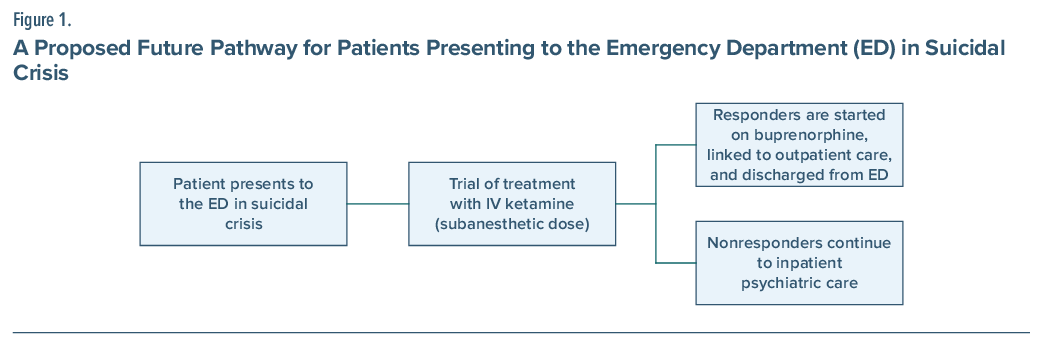
If future studies demonstrate safety and effectiveness, selected ED patients who respond to ketamine may eventually be candidates for structured outpatient pathways. This approach could combine low dose buprenorphine, development of a safety plan, and rapid psychiatric follow-up or linkage to telemedicine or online-based behavioral interventions for ongoing psychiatric care rather than prolonged boarding while awaiting psychiatric admission (Figure 1). Such an approach could improve outcomes by avoiding potential harms associated with ED boarding, improve the patient experience, and preserve inpatient resources for others who require hospitalization. This pathway could be available to any practicing ED physician regardless of inpatient psychiatric bed, consultant, or outpatient care availability in the case of internet-based CBT. More importantly, this model would shift the focus of the ED physician from simply determining disposition to initiating treatment that extends beyond the acute encounter.
Challenging the Current Paradigm: Remaining Barriers
While preliminary data are encouraging that there may be a future wherein ED clinicians can bridge select patients in suicidal crisis to outpatient care, evidence is required at each step of the pathway proposed in Figure 1. Ketamine must first have proof of efficacy in ED patients in suicidal crisis, and the population who may benefit must be defined. Buprenorphine or alternate add-on therapy would need to be trialed in the ED setting. Validated outpatient linkage to care after receipt of ED-based pharmacologic interventions for suicidal crisis needs to be developed. Future trials would also be needed to evaluate outcomes relevant to emergency care, including repeat ED visits, psychiatric hospitalizations, suicide attempts, treatment engagement, and successful linkage to outpatient services. Further study should also be undertaken to identify whether this pathway may be useful in pediatric populations, as suicide remains among the leading causes of death in adolescents and young adults. While there remain significant questions to be answered before the proposed pathway could be implemented, preliminary data should inspire continued research toward a common goal of improved evidence-based and patient-centered care for those presenting to the ED in suicidal crisis.
Conclusions
The ED is often where patients first seek care during suicidal crisis. It provides a unique opportunity to initiate evidence-based interventions for suicidal crisis. While preliminary studies suggest that ketamine, and potentially adjunctive buprenorphine, may improve short-term outcomes, substantial work remains before these approaches can be incorporated into routine emergency care. Future clinical trials should define appropriate patient selection, treatment protocols, safety, and outpatient care pathways before implementation can be recommended.
Article Information
Published Online: October 19, 2026. https://doi.org/10.4088/JCP.26ac16639
© 2026 Physicians Postgraduate Press, Inc.
J Clin Psychiatry 2026;88(1):26ac16639
To Cite: Maguire LA, Jha MK, Murphy N, et al. Bridging suicidal crisis to outpatient care: could ketamine plus buprenorphine shift the paradigm? J Clin Psychiatry. 2026;88(1):26ac16639.
Author Affiliations: Department of Emergency Medicine, University of Kansas School of Medicine-Kansas City, Kansas City, Kansas (Maguire); Department of Psychiatry, UT Southwestern Medical Center, Dallas, Texas (Jha); Department of Psychiatry and Behavioral Sciences, Naresh K. Vashisht College of Medicine, Texas A&M University, Bryan, Texas (Murphy); Henry J.N. Taub Department of Emergency Medicine, Baylor College of Medicine, Houston, Texas (Thomas); Center for Innovations in Quality, Effectiveness, and Safety (IQuESt), Michael E. DeBakey Veterans Affairs Medical Center, Houston, Texas (Thomas); Menninger Department of Psychiatry and Behavioral Sciences, Baylor College of Medicine, Houston, Texas (Thomas).
Corresponding Author: Lindsay A. Maguire, MD, Department of Emergency Medicine, University of Kansas Medical Center, Kansas City, KS 66160 ([email protected]).
Financial Disclosures: In the past 36 months, Dr Jha has received contract research grants from Neurocrine Biosciences, Navitor/Supernus, and Janssen Research & Development; honorarium to serve as Section Editor of the Psychiatry & Behavioral Health Learning Network and as Guest Editor for Psychiatric Clinics of North America from Elsevier; consultant fees from Janssen Scientific Affairs, Sanofi, Neurocrine, Abbvie, MindMed, and Boehringer Ingelheim; fees to serve on Data Safety and Monitoring Board for Worldwide Clinical Trials (Eliem, Skye, and Inversargo), Vicore Pharma, and IQVIA (Click); and honoraria for educational presentations from North American Center for Continuing Medical Education, Medscape/WebMD, Clinical Care Options, Soterix Medical Inc., Physicians’ Education Resource, Efficient CME, and H.C. Wainwright & Co. The other authors have no financial disclosures.
Funding/Support: Dr Thomas acknowledges partial support from the Houston VA HSR&D Center for Innovations in Quality, Effectiveness and Safety (CIN13-413) through the use of their resources and facilities. Dr Jha is supported by a National Institute of Mental Health career development award (MH126202) and by the O’Donnell Clinical Neuroscience Endowed Scholar position at UT Southwestern.
Journal of Clinical Psychiatry, all rights reserved.
Recent Posts
Apogem Capital Leads Minority Investment in Family Care Center
Laura Lovett | October 21, 2026
Do Psychedelics Need a Rebrand Before Their Approval for Mental Health?
Ashleigh Hollowell | October 21, 2026
Virginia mental health provider to settle Medicaid billing allegations for $1.8M
Ella Ruder | October 21, 2026
Covenant Health taps behavioral health VP
Ella Ruder | October 21, 2026
Ketamine drugmakers seek FDA approval as providers raise concerns: 5 things to know
Ella Ruder | October 21, 2026
Integrated Psychiatric Consultants
Office Hours:Mon-Fri, 9 a.m. - 5 p.m. CT